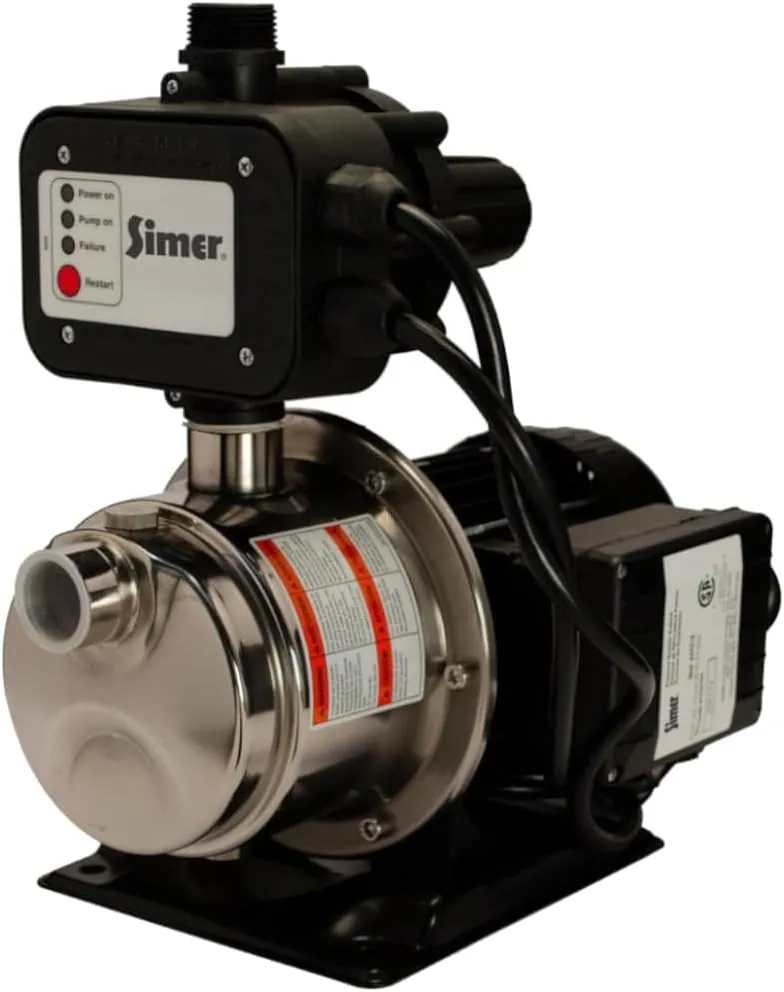
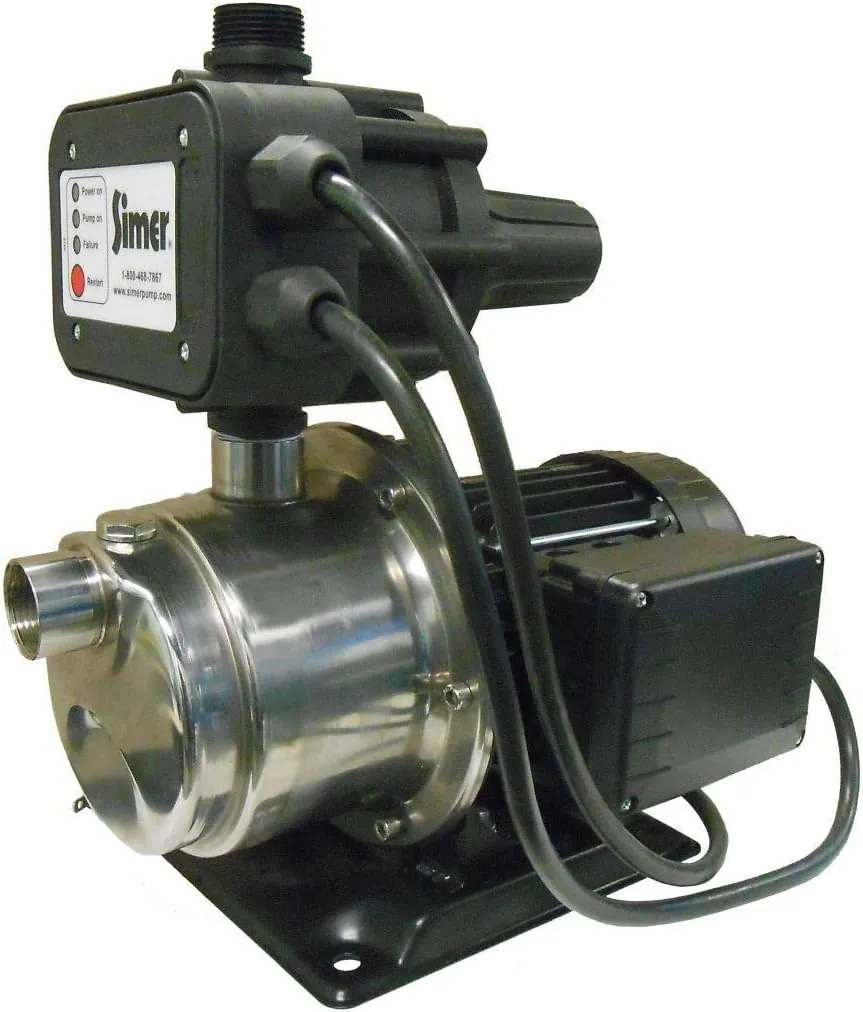
Quick verdict
A sensible fix for a house on weak municipal pressure: it sits on the incoming line, starts when a tap opens and stops a few seconds after flow ends. The built-in controller guards against running dry. It is not a well pump and not a hot-water circulator, and the maker limits incoming pressure to between 10 and 50 PSI.
Who it fits, and who should skip it
A good fit if
- City water reaches the house at low but steady pressure.
- You want a plug-in booster rather than a hard-wired one.
- Showers and sprinklers lose pressure when two run at once.
Look elsewhere if
- Incoming pressure is below 10 PSI or above 50 PSI.
- You need to lift water from a well or tank with no pressure.
Specifications
Motor
| Horsepower | 3/4 HP |
|---|---|
| Voltage | 115 V, 60 Hz; 6 ft cord with grounded plug |
Figures: Simer Model 4075SS booster pump data sheet; Simer automatic booster pump owner's manual 253PB560 (4075SS-01).
Performance
| Max flow | 24 GPM |
|---|---|
| Pressure boost | Up to 40 PSI added |
| Boost table | 10, 20, 30, 40 PSI in become 50, 60, 70, 80 PSI out |
Figures: Simer Model 4075SS booster pump data sheet.
Limits
| Inlet pressure | 10 to 50 PSI (70 to 345 kPa) |
|---|---|
| Max boosted pressure | Do not exceed 100 PSI (689 kPa) |
Figures: Simer automatic booster pump owner's manual 253PB560 (4075SS-01).
Control
| Controller | Automatic pressure controller with run-dry, rapid-cycle and pressure-drop protection |
|---|---|
| Restart flow | Starts on flow above 1/4 GPM |
Figures: Simer automatic booster pump owner's manual 253PB560 (4075SS-01).
Build
| Connections | 1 in female NPT intake, 1 in male NPT discharge |
|---|---|
| Housing | Stainless steel pump housing on a mounting base |
| Model number | 4075SS-01 |
| Shipping weight | 26 lb |
| Warranty | 3-year limited |
Figures: Simer Model 4075SS booster pump data sheet; Simer automatic booster pump owner's manual 253PB560 (4075SS-01).
Installation and setup
Mount the pump level on a solid base near the main supply line, where it stays dry and cannot freeze. Shut off the main, relieve the pressure, and cut in elbows so the pump sits in a loop of rigid pipe; Simer forbids flexible hoses. Fit a union on each side, an elbow on the discharge, and a check valve on the suction side with its arrow toward the pump; the check valve is bought separately. Add a relief valve on the discharge able to pass full flow at 100 PSI if the plumbing lacks one, and consider the recommended low-pressure cutoff. A bypass lets the house keep water if the pump is ever removed.
Seal threads with PTFE tape only, tighten joints hand-tight plus 1-1/2 turns, then pressurise, bleed air at a tap and plug into a GFCI outlet.
Switch and sizing notes
There is no pressure switch to adjust. The controller starts the pump when it senses flow above 1/4 GPM and stops it several seconds after flow ends, which avoids rapid cycling when taps open and close. If it senses no water, it stops and lights the Failure LED; hold Restart for five seconds once the supply is back.
Sizing is about your starting pressure. Simer's table shows the boost: 30 PSI in becomes 70 PSI out. Because the maker caps the boosted system at 100 PSI and the inlet at 50 PSI, a house already near 50 PSI gains little. Pipe and fittings should be at least 1 in, as smaller pipe cuts flow and can cause cavitation. The booster guide walks through measuring your pressure first.
Ownership and maintenance
The motor bearings are lubricated for life and the seal is water-cooled, so routine care is about the system. If the pump starts with no tap open, look for a leak: Simer's test is to close the main, unplug the pump and confirm the house holds pressure. Debris can hold the controller's discharge valve open. The motor has an auto-reset thermal overload; repeated trips point to low voltage or a clogged impeller.
Pros and cons
Pros
- Adds up to 40 PSI with no wiring.
- Controller protects against running dry.
- Stainless steel pump housing.
- Current model with a 3-year warranty.
Cons
- Check valve and relief valve bought separately.
- Inlet must stay between 10 and 50 PSI.
Alternatives worth comparing
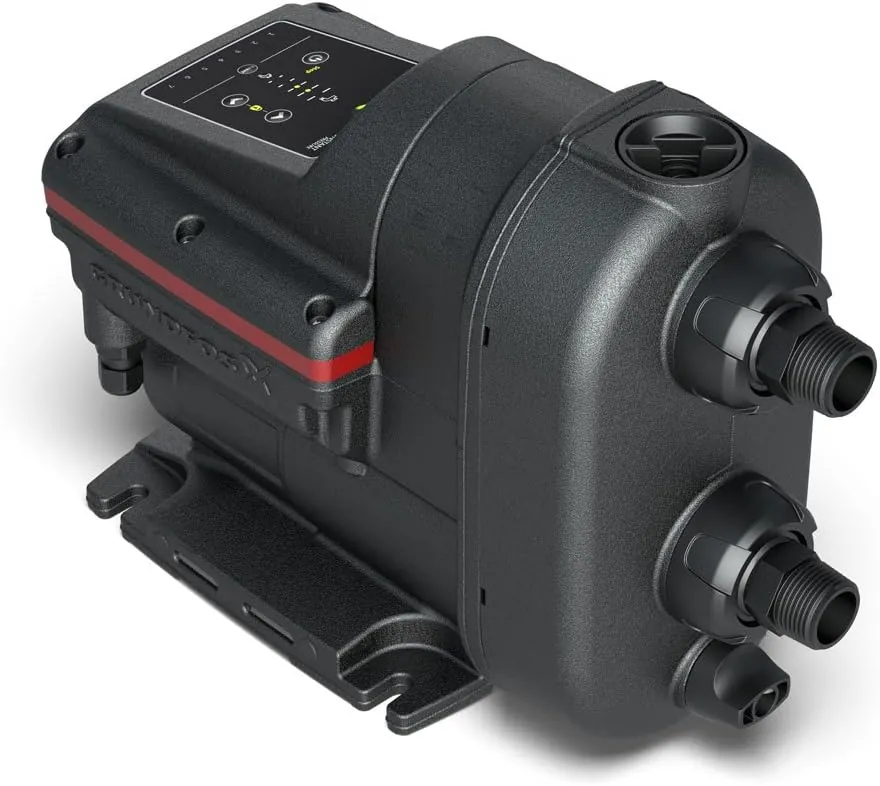
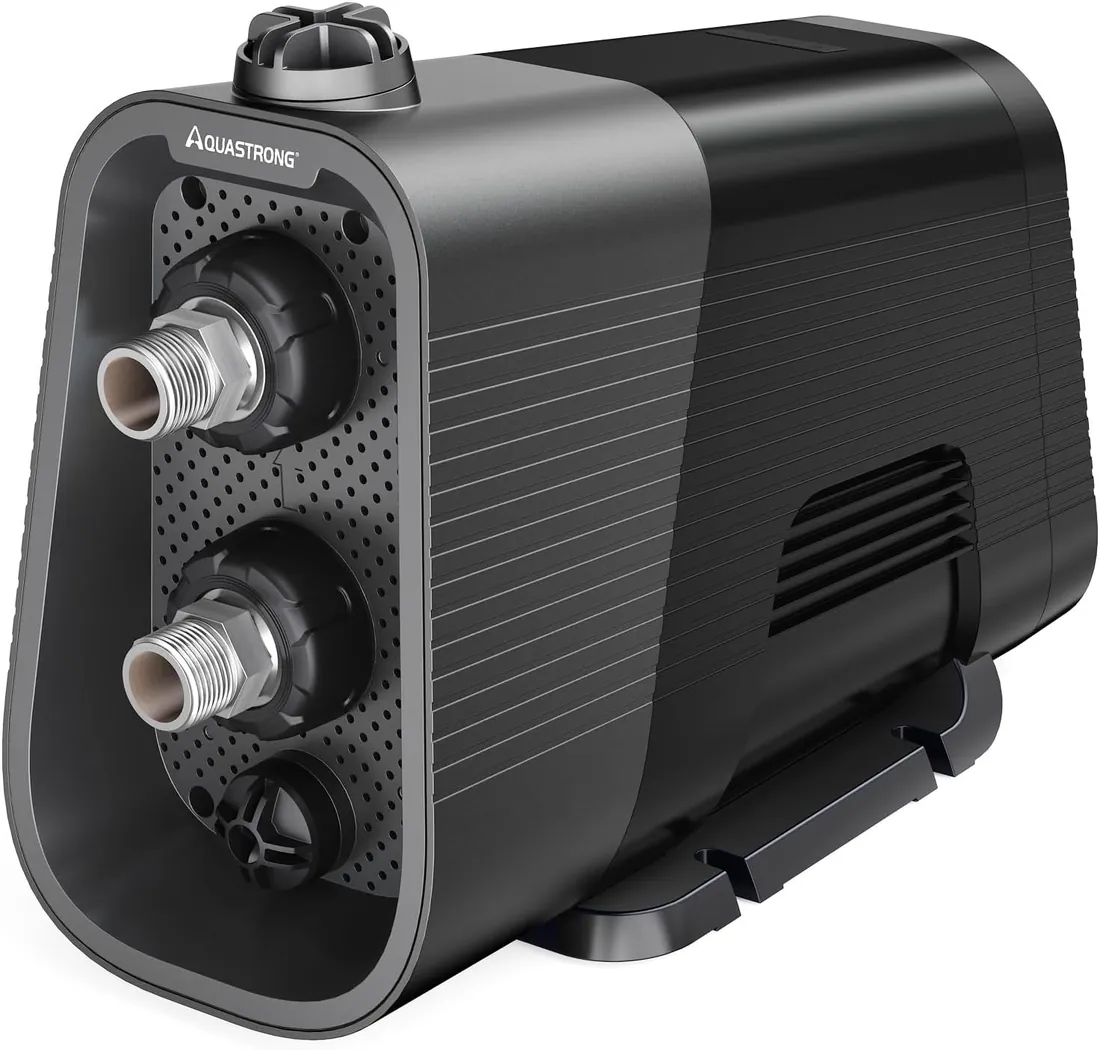
Compared with and featured in
Final verdict
Choose the 4075SS to lift weak city pressure by up to 40 PSI with a plug-in pump and an automatic controller. Measure your incoming pressure first, and budget for a check valve and relief valve.
Where to buy
Each button opens this exact model's listing. We may earn a commission on tracked links; it never changes what we publish. Disclosure
Questions buyers ask
How much pressure does the Simer 4075SS add?
Up to 40 PSI. Simer's data sheet shows 10 PSI in becoming 50 PSI out, and 40 PSI in becoming 80 PSI out. The boost falls as flow rises, so expect less at full flow.
Can the 4075SS boost water from my well?
It can boost an existing well system, but Simer warns that leaky check valves can make the booster start and cycle when the well pump is off. It cannot lift water from a well on its own.
Why does my Simer booster show a Failure light?
The controller has detected no water reaching the pump and stopped it to prevent a dry run. Check that the suction valve is open and supply is restored, then hold Restart for five seconds.
Does the Simer 4075SS need a pressure tank?
The manual's standard layout uses no tank: the controller runs the pump on demand and holds it on a few seconds after flow stops. Local code may still call for a relief valve or regulator.