A booster pump sits on the main supply line and starts when a tap opens, adding pressure on top of what arrives. Simer's 3075SS and 4075SS add up to 40 psi at up to 24 GPM; Grundfos's SCALA2 holds a set outlet pressure from 22 to 80 psi. You need one when supply pressure is low at the meter, not when it drops inside the house.
What a booster pump does
A water pressure booster is a small centrifugal pump with an automatic controller, plumbed into the main supply line after the meter or tank. When a tap opens, the controller senses flow or falling pressure and starts the pump, which adds pressure to the water passing through. When flow stops, it runs a few more seconds and shuts off. Simer's 4075SS manual describes exactly that cycle: flow above 1/4 GPM restarts the pump, and a short delay after flow stops prevents rapid cycling when taps are turned on and off quickly.
The important point is that a booster adds pressure; it does not create water. Simer rates its 4075SS and 3075SS at a maximum of 40 psi of added pressure, so a house receiving 40 psi could see up to 80. If the supply itself is starved, the booster will run dry, and Simer's controller is built to detect that and stop the pump.
| Pump | Motor | Rated output | Control |
|---|---|---|---|
| Simer 3075SS | 3/4 HP, 115 V | Up to 24 GPM; adds up to 40 psi | Automatic flow and pressure controller |
| Simer 4075SS | 3/4 HP, 115 V | Up to 24 GPM; adds up to 40 psi | Controller with run-dry protection |
| Grundfos SCALA2 3-45 | Variable speed | Set outlet pressure 22 to 80 psi | Built-in pressure tank, factory 44 psi |
Figures: Simer 3075SS booster pump data sheet; Simer 4075SS booster pump data sheet; Grundfos SCALA2 installation and operating instructions.
Signs you actually need one
A booster helps when the pressure arriving at the house is low. Typical cases are homes at the end of a long municipal main or on high ground, upper floors where the supply loses pressure climbing, and houses fed by gravity from a storage tank or cistern. The quickest check is a pressure gauge on an outdoor hose bib or the laundry tap, read with nothing else running and again with a shower on.
If pressure is low only at one fixture, the cause is local: a clogged aerator, a failing cartridge or a restricting filter. If it is fine at the meter but poor inside, look for undersized or corroded pipe; Simer's own troubleshooting lists corroded pipes and piping too small as reasons a booster cannot deliver full capacity. A booster will not cure either. And if your pressure is high and you want gentler showers, you need a pressure regulator, not a pump.
- Read a gauge at a hose bib with all water off.
- Read it again with a shower and a tap running.
- Compare with other taps to rule out a single fixture.
- Check any whole-house filter for clogging.
Booster pump vs pressure tank on a well
On a private well, the well pump and its pressure switch already set the house pressure. If it is low, the first step is usually the switch setting, raising a 30/50 switch to 40/60 if the pump can reach it, and resetting the tank precharge to match. The pressure switch guide shows how. A larger pressure tank lengthens cycles but does not raise pressure.
A booster after the well system makes sense when the well pump cannot reach a higher setting, or when water comes from a storage tank filled slowly by a low-yield well. Simer warns that when boosting a well supply the check valves must be tight; if system pressure drops while the well pump is off, the booster may start and cycle, which can damage the motor and void the warranty.
Booster vs circulation, recirculation and transfer pumps
Several pumps look similar and are easy to confuse. A circulator, such as Grundfos's UP15-42F, moves water around a closed heating loop; it adds almost no pressure and is not meant for drinking water service in that form. A hot water recirculation pump moves water from the far end of the hot line back to the heater so hot water arrives faster; it does not raise pressure either. The recirculation guide covers those.
A transfer pump moves water from one place to another, such as emptying a tank or a flooded area, and has no automatic pressure control. A jockey pump, a term from fire sprinkler systems, keeps a large system topped up at pressure. Only a booster with an automatic controller is designed to sit on a household supply and respond to taps opening.
Limits the makers set
Boosters have firm inlet and outlet limits. Simer says not to use the 4075SS with inlet pressure below 10 psi or above 50 psi, and warns that the pump body may burst if used to boost above 100 psi, so it requires a relief valve on the discharge able to pass full flow at 100 psi unless local code calls for a lower setting. It recommends a low-pressure cut-off switch in case the supply fails, and requires a check valve on the suction side.
Grundfos sets a different kind of limit on the SCALA2: the difference between inlet and outlet pressure must not exceed 51 psi, and the sum of inlet pressure and pump head must stay within the pump's rating. The SCALA2 can also lift water from a tank, up to 26 ft of suction lift, which the Simer units are not designed for. The booster pump list compares the models in more detail.
Whole-house or point-of-use
Whole-house boosters like the Simer and Grundfos units sit on the main line and serve every fixture, sized for the flow of several taps at once. Small inline boosters sold for a single shower or garden hose exist, but our catalog does not carry maker documentation for them, so their real ratings are hard to judge. For a whole house, a pump with a published flow and pressure rating, run-dry protection and a proper controller is the safer choice. Installation details, including the bypass that lets you remove the pump without cutting off the water, are in the booster installation guide.
Common mistakes
- Installing a booster to fix a clogged aerator or a failing shower cartridge.
- Feeding a booster from a supply that cannot keep up, so it runs dry.
- Skipping the relief valve on the booster's discharge line.
- Boosting a well supply with leaking check valves, causing constant cycling.
- Confusing a hydronic circulator with a pressure booster.
Products that fit
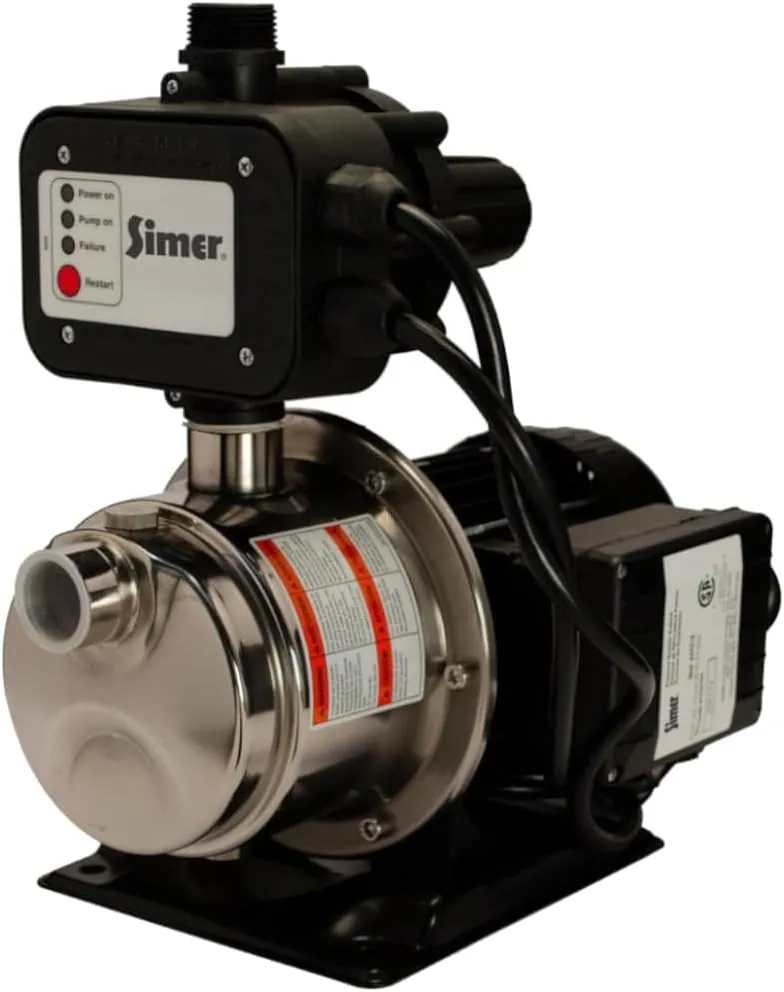
Simer 4075SS Pressure Booster Pump
3/4 HP booster adding up to 40 psi, with run-dry protection.
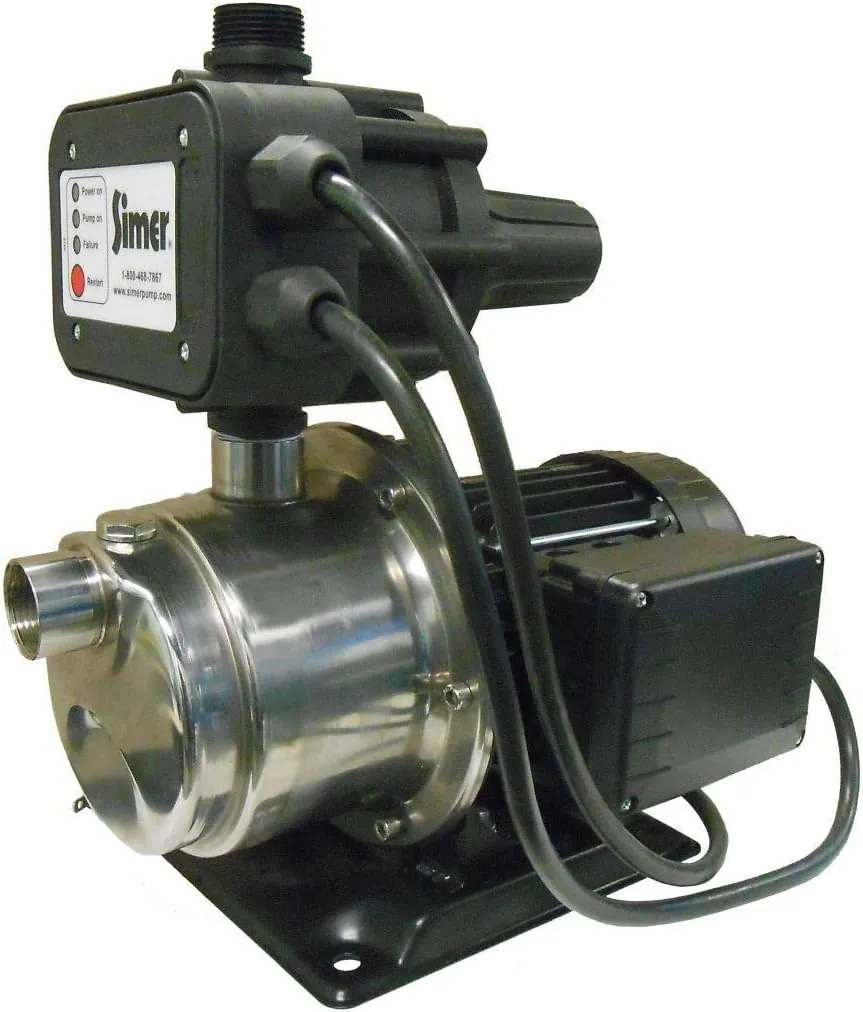
Simer 3075SS Pressure Booster Pump
Earlier 3/4 HP Simer booster rated at up to 24 GPM.
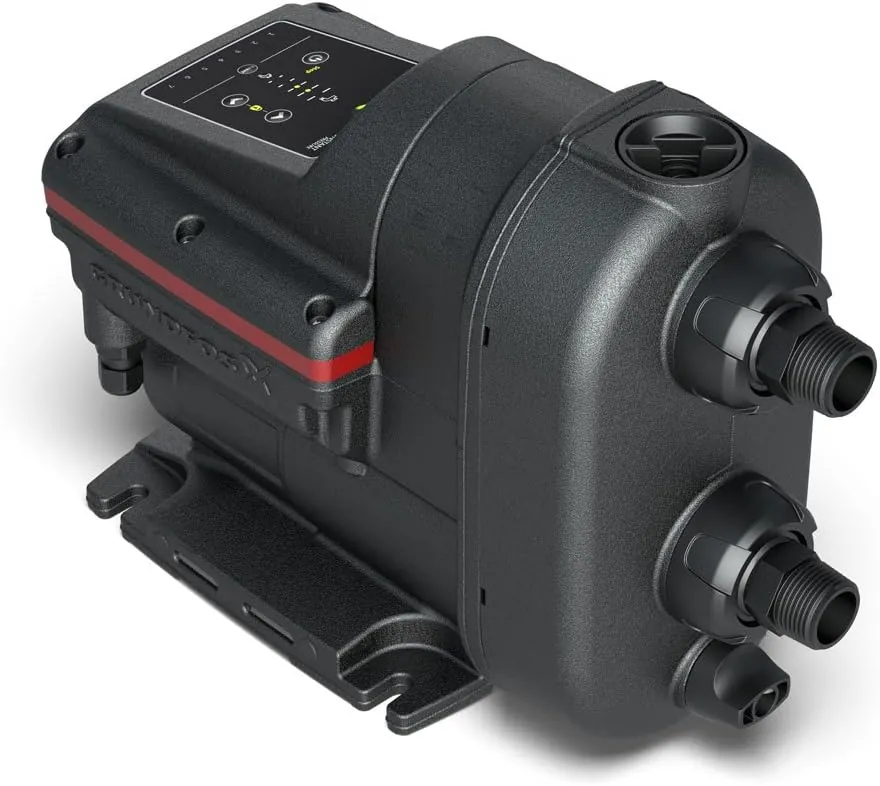
Grundfos SCALA2 3-45 Booster Pump
Grundfos variable-speed booster with a built-in tank and an adjustable setpoint.
Questions readers ask
How does a water pressure booster pump work?
A controller senses flow or falling pressure when a tap opens and starts the pump, which adds pressure to the incoming water. When flow stops, it runs a few seconds longer and stops. Simer's units restart on flow above 1/4 GPM.
How much pressure does a booster pump add?
It depends on the model. Simer rates the 3075SS and 4075SS at up to 40 psi of added pressure. Grundfos's SCALA2 instead holds a set outlet pressure, adjustable from 22 to 80 psi, as long as the gain does not exceed 51 psi.
Can I use a booster pump with a well?
Yes, but check the well system first. Raising the pressure switch setting is often enough. If you do add a booster, Simer warns that the well's check valves must be tight, or the booster will cycle.
Is a booster pump the same as a recirculation pump?
No. A recirculation pump moves hot water back to the heater so it arrives faster at the tap; it does not raise pressure. A booster raises pressure on the main supply.