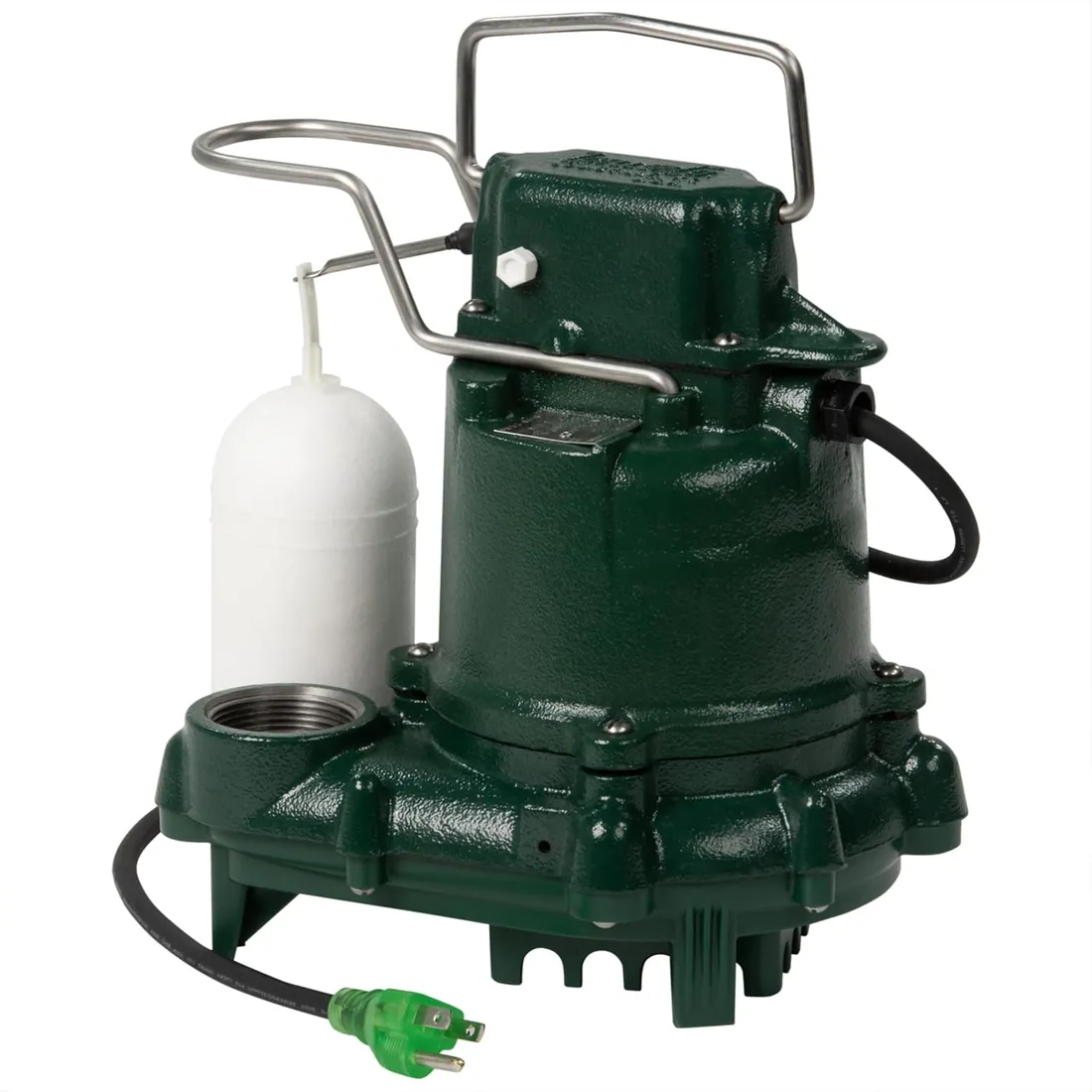
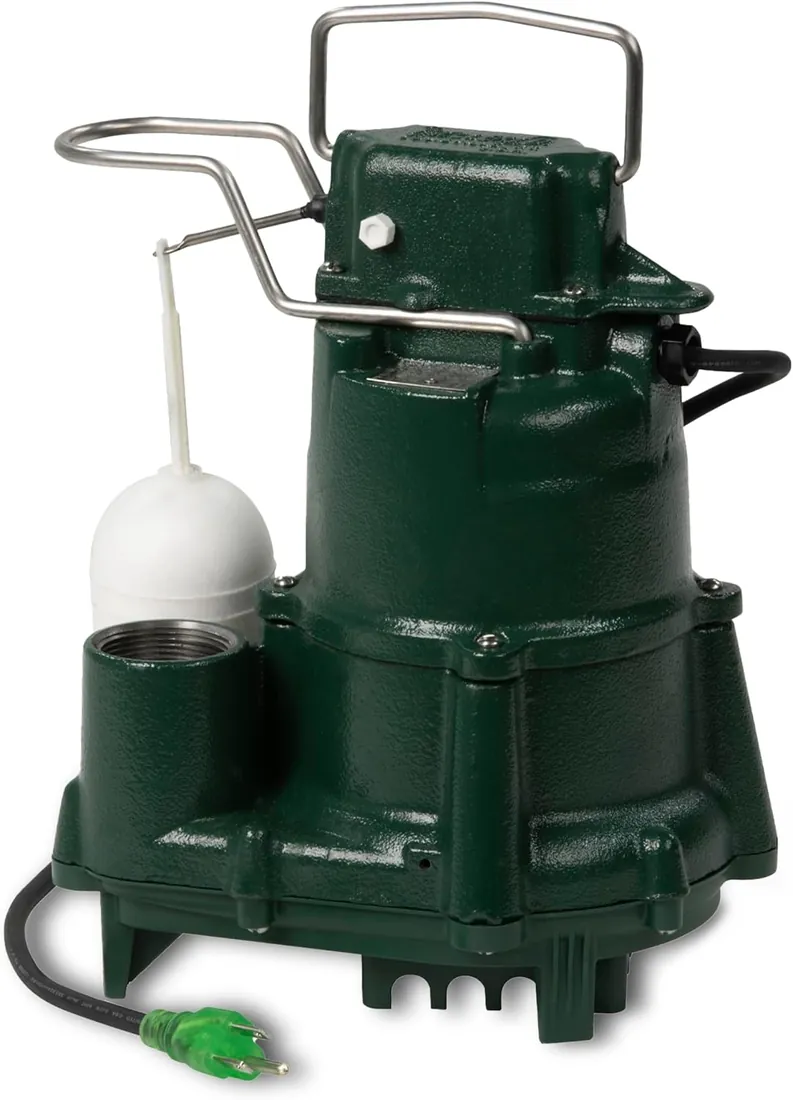
Choose the Zoeller M53 when the pipe climbs about 10 ft or less, the pit fills at a steady, modest rate and you want a lighter pump that starts lower in the basin.
Choose the Zoeller M98 when the discharge climbs higher, runs a long way, or the pit fills fast in storms, because it still moves real water where the M53 has already stopped.
Key specifications
| Specification | Zoeller M53 Mighty-Mate Sump Pump | Zoeller M98 Flow-Mate Sump Pump |
|---|---|---|
| Horsepower | 3/10 HP | 1/2 HP |
| Motor | Shaded pole, 1550 RPM | Permanent split capacitor, 1725 RPM |
| Amps at 115 V | 9.7 A | 9.4 A |
| Max flow | 43 GPM | 72 GPM |
| Flow at 10 ft | 34 GPM | 61 GPM |
| Flow at 15 ft | 19 GPM | 45 GPM |
| Flow at 20 ft | None (shut-off 19.25 ft) | 25 GPM |
| Shut-off head | 19.25 ft | 23 ft |
| Switch levels (automatic) | On 7-1/4 in, off 3 in | On 9-1/2 in, off 3 in |
| Bearings | Sleeve bearings | Oil-fed cast iron bearings |
| Housing | Cast iron cap, motor and pump housing | Cast iron cap, motor and pump housing |
| Weight (automatic) | 23 lb | 36 lb |
| Discharge and solids | 1-1/2 in NPT, 1/2 in solids | 1-1/2 in NPT, 1/2 in solids |
| Warranty | 3-year limited | 3-year limited |
Figures: Zoeller technical data sheet FM2778, Mighty-Mate series (models 53, 55, 57, 59); Zoeller technical data sheet FM2779, Flow-Mate Model 98; Zoeller Model 53 product page; Zoeller Model 98 product page.
Scorecard
| Criterion | Edge | Why |
|---|---|---|
| Flow at a 10 ft lift | Zoeller M98 Flow-Mate Sump Pump | The M98 table shows 61 GPM at 10 ft against 34 GPM for the M53, close to double. |
| Reach for a high discharge | Zoeller M98 Flow-Mate Sump Pump | The M98 is still moving 25 GPM at 20 ft; the M53 shuts off just past 19 ft. |
| Weight to lift in and out | Zoeller M53 Mighty-Mate Sump Pump | At 23 lb the M53 is much easier to pull from a deep pit than the 36 lb M98. |
| Water left in the pit | Zoeller M53 Mighty-Mate Sump Pump | The M53 starts at about 7-1/4 in, so it holds the water lower before each cycle begins. |
| Warranty | Even | Zoeller covers both automatic models for three years under the same terms. |
What the extra horsepower buys
Zoeller's tables tell the story. Near the floor of the curve the M53 moves 43 GPM and the M98 72 GPM. At 10 ft of total head the gap holds, 34 GPM against 61 GPM. By 15 ft the smaller pump has dropped to 19 GPM while the M98 still delivers 45 GPM, and the M53 stops altogether just past 19 ft.
Total head is the vertical climb from the pit to the highest point of the pipe, plus an allowance for friction in the run and fittings. A typical basement with a short run out through the rim joist sits well inside the M53's range. A pipe that rises through a finished ceiling, crosses the house or exits far up a slope pushes toward the zone where only the M98 still pumps usefully. The sizing calculator adds this up for you.
Two different motors
The M53 runs a shaded pole motor at 1550 RPM on sleeve bearings. It is a simple, long-proven design that suits short, frequent cycles. The M98 uses a permanent split capacitor motor at 1725 RPM on oil-fed cast iron bearings, which is how Zoeller gets half a horsepower out of a body only a little taller than the M53.
Current draw is close: 9.7 A for the M53 and 9.4 A for the M98 at 115 V. That means the larger pump does not need a bigger circuit than the smaller one, though Zoeller still recommends a separate branch circuit for either. Both motors are oil-filled and protected by an automatic reset thermal overload.
Switch levels and pit depth
Both automatic pumps carry an integral float switch inside a guard, but the M98 waits longer to start. It switches on at about 9-1/2 in and off at about 3 in, while the M53 switches on at about 7-1/4 in and off at the same 3 in. The M98 therefore empties a deeper slice of water each cycle, which means fewer starts in a busy pit.
The flip side is that the water sits higher before the M98 reacts. If the inlet pipe enters the basin low, check that a 9-1/2 in start point stays below it, or water will back up into the drain tile before the pump runs. Our basin size and cycle time guide covers the arithmetic.
Size, weight and materials
Both pumps wear cast iron on the cap, motor housing and pump housing, with a powder-coated epoxy finish and stainless hardware. The M53 sits on an engineered thermoplastic base with a plastic impeller. The M98 sheet allows a thermoplastic or cast iron base and impeller depending on version, and its sales sheet lists an engineered thermoplastic base and plastic impeller for the plug-in model.
The real physical difference is mass. The automatic M98 weighs 36 lb against 23 lb for the M53. That weight helps the larger motor shed heat, but it makes pulling the pump from a deep, wet pit a two-handed job. Both share the same 1-1/2 in NPT discharge and pass the same 1/2 in spherical solids.
Versions and upkeep
Each pump comes as a family. The M53 line includes nonautomatic, piggyback-float and 230 V builds, and the M98 line mirrors it with the N98, D98, E98, BN98 and BE98. The BN and BE versions of the M98 add a piggyback variable-level float on a 20 ft cord for wider pumping ranges, and Zoeller recommends a pit of 18 in or more across when a variable-level float is used.
Care is identical: a check valve with a vent hole of about 3/16 in below it, a pit kept free of debris, and a run test at least every three months. Both carry Zoeller's LED plug, which lights when the outlet has power.
When stepping up is a mistake
Bigger is not automatically better in a sump. A pump that empties a small basin in a few seconds starts and stops far more often than it needs to, and every start wears the switch and warms the motor. If your pit is a narrow plastic liner and the water arrives slowly, the M98 can short cycle where the M53 would run a calm, steady rhythm.
The opposite mistake is just as common. An M53 fighting a high lift runs long cycles at the thin end of its curve and may never catch up in a downpour. Watch the old pump during the next heavy rain: if it barely gains on the water, step up; if it empties the pit in moments, stay with the smaller model.
Who each one fits
The Zoeller M53 Mighty-Mate Sump Pump fits if
- The discharge climbs about 10 ft or less.
- Inflow is steady rather than sudden.
- You would rather lift a 23 lb pump.
- The inlet pipe enters low in the basin.
- You want the most widely stocked Zoeller.
The Zoeller M98 Flow-Mate Sump Pump fits if
- The pipe climbs 15 ft or more to the outlet.
- The pit fills quickly during storms.
- You want fewer starts per hour in a busy pit.
- A long horizontal run adds friction to the lift.
- You may later add a variable-level float in a wide pit.
Questions readers ask
Is the Zoeller M98 overkill for an ordinary basement?
Often, yes. If the pipe climbs about 10 ft and the pump runs a few short cycles in heavy rain, the M53's 34 GPM at that lift is plenty. The M98 earns its keep with higher lifts, long runs or a pit that fills faster than the smaller pump can empty it.
Can I replace an M53 with an M98 in the same pit?
Usually. Both use a 1-1/2 in NPT discharge, so the pipe and check valve stay. Check that the taller M98 and its 9-1/2 in start level suit the pit depth and the height of the inlet pipe, and that the lid still closes.
Does the M98 use more electricity?
Running current is similar, 9.4 A for the M98 and 9.7 A for the M53 at 115 V. Because the M98 moves more water per minute, it often runs for less time on each cycle, so the total draw per storm need not be higher.
Do both pumps need a vent hole?
Zoeller builds a vent into both pump housings but still recommends drilling a hole of about 3/16 in in the discharge pipe below the check valve and pit cover, then keeping it clear so trapped air cannot stop the pump from moving water.
Final verdict
Let the lift decide. For a short, low discharge and a steadily filling pit, the M53 does the job with less weight and a lower start point. Once the pipe climbs past about 15 ft, runs long or must keep pace with storm surges, the M98's flatter curve and 23 ft shut-off make it the safer pump. Measure total head before you buy, and the answer is rarely close.