Measure the vertical lift from the pit floor to where the pipe leaves the house, add an allowance for the horizontal run and fittings, and read the pump's flow at that total head on the maker chart. Pick a pump whose flow at that head clearly exceeds how fast your pit fills in heavy rain. For most basements with lifts under about ten feet, a 1/3 HP pump is enough.
Start with head, not horsepower
Every sump pump loses flow as it lifts water higher, and at some height it stops moving water altogether. That height is the shut-off head. Two pumps with the same horsepower can behave very differently at your lift, so the first number to find is the total head your pump will work against.
Total head has two parts. The vertical lift is the height from the water level in the pit, which is close to the pit floor, up to the highest point of the discharge pipe, usually where it passes through the rim joist or wall. Friction head is the extra resistance from pipe length, elbows and the check valve. Zoeller's sizing advice lists exactly these inputs: vertical lift, horizontal run, pipe size, the number and type of fittings, and any back pressure at the outlet.
For a short, straight run the friction allowance is small. For a long run across a yard, several elbows or a narrow pipe it can add several feet. The sump pump sizing calculator adds the friction for you.
Read flow at your head from the maker chart
Once you know your total head, find that height on the maker's performance table and read across. Wayne publishes its whole range in one table, which makes it a clear way to see how horsepower and lift interact. Notice how fast the smaller pumps fall away: the 1/3 HP CDU790 moves 4,600 GPH with no lift but 1,200 GPH at 20 ft.
| Model | Power | 0 ft | 10 ft | 15 ft | 20 ft |
|---|---|---|---|---|---|
| CDU790 | 1/3 HP | 4,600 | 3,060 | 2,220 | 1,200 |
| CDU800 | 1/2 HP | 5,100 | 3,840 | 3,060 | 2,040 |
| CDU980E | 3/4 HP | 5,490 | 4,600 | 4,100 | 3,500 |
| CDU1000 | 1 HP | 6,100 | 5,100 | 4,560 | 3,840 |
Figures: Wayne submersible sump pump manual 600002W-001 J.
How much water do you actually need to move?
The pump only has to beat the water arriving in the pit. The simplest way to find that rate is to watch your pit during a heavy rain. Unplug the pump briefly, time how long the water takes to rise a measured height, then plug it straight back in. The pit's area times that rise gives the volume, and dividing by the time gives gallons per minute. Do this during the wettest weather you can, because that is when the pump has to keep up.
Choose a pump whose flow at your total head comfortably exceeds that inflow. A pump that only just matches the inflow will run nonstop in storms, and Wayne's troubleshooting chart treats a pump that will not shut off because of excessive inflow as a sizing problem. Going much larger than you need has a cost too: an oversized pump in a small pit empties it in seconds and short cycles.
What 1/3, 1/2 and 3/4 HP pumps suit
With those numbers in hand, horsepower becomes a shorthand. A 1/3 HP pump such as the Wayne CDU790 or the Superior 92341 suits a typical basement with a lift of under about ten feet and ordinary inflow. Superior lists the 92341 at 2,760 GPH with no lift and 1,800 GPH at 10 ft, which shows how much ratings vary even within one horsepower class.
A 1/2 HP pump such as the Wayne CDU800 or Zoeller M98 fits deeper basements, high water tables or long discharge runs. Zoeller rates the M98 at a 23 ft shut-off head against 19.25 ft for its 3/10 HP M53. Pumps of 3/4 HP and up, such as the Wayne CDU980E, are for high lifts or pits that fill very quickly. The 1/2 HP and larger list compares the bigger options.
Discharge pipe size
Most house sump pumps have a 1-1/2 in NPT discharge, including the Zoeller M53 and M98, the Liberty 257 and the Superior 92341. The rule from every maker is the same: never go smaller than the pump outlet. Liberty warns that reducing the discharge below the pump's outlet reduces performance and efficiency, and adds that larger pipe may be needed on long runs to cut friction. Zoeller's install checklist says the same in one line.
A hose-barb adapter or a narrow flexible hose on a permanent install chokes the pump. Wayne requires rigid PVC for permanent installs and says not to use flexible hosing, partly because a moving hose can shift the pump and upset the switch.
Match the pump to the basin and switch
Size the pump and the pit together. Wayne asks for a basin at least 11 in across for its vertical-float pumps and 14 in for its tethered models, with a minimum height of 22 in. Vertical floats suit narrow pits; tethered floats need room to swing but give a longer pumping range. Liberty recommends at least 14 in across for ordinary groundwater, while allowing its vertical-float 257 in a 10 in sump.
One more check: Wayne states that its sump pumps are not designed to run on a portable generator. If you plan to rely on one during outages, confirm with your pump's maker or add a battery backup instead.
Common mistakes
- Buying by horsepower without reading flow at your own lift.
- Measuring lift from the floor rather than from the pit bottom to the outlet.
- Necking the discharge down to a smaller hose or pipe than the pump outlet.
- Choosing a far larger pump than the inflow needs and causing short cycling.
- Ignoring friction from a long horizontal run with several elbows.
Products that fit
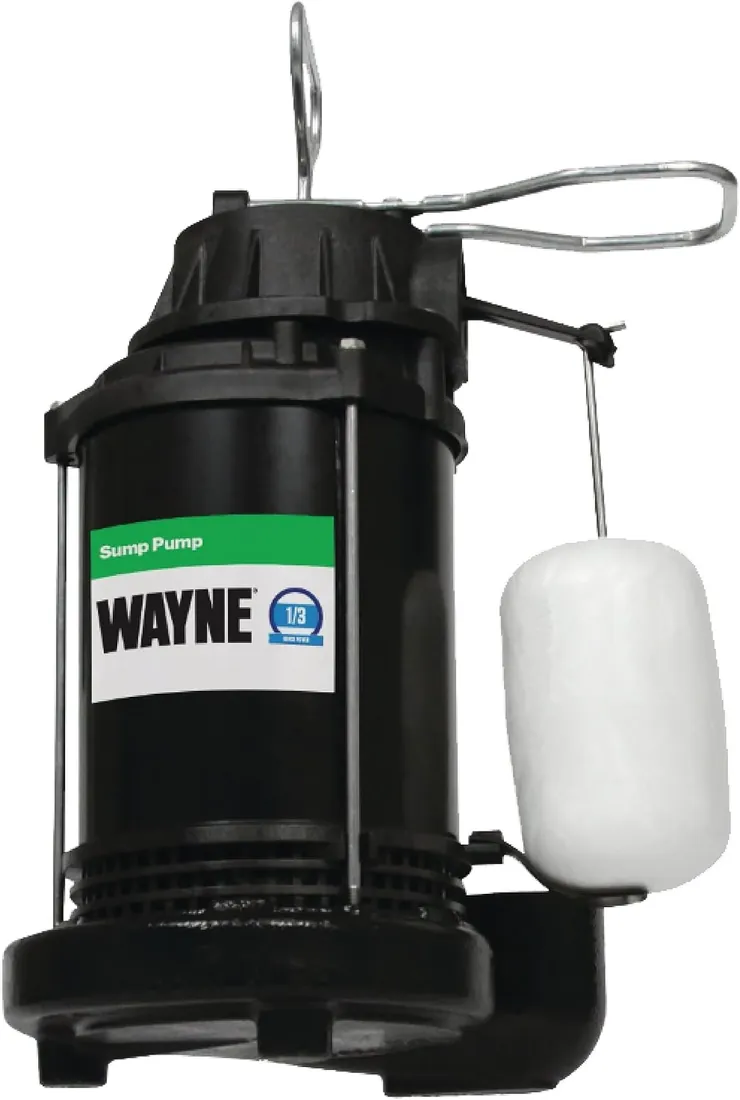
Wayne CDU790 Sump Pump
1/3 HP pump with a published flow table from no lift to 20 ft.
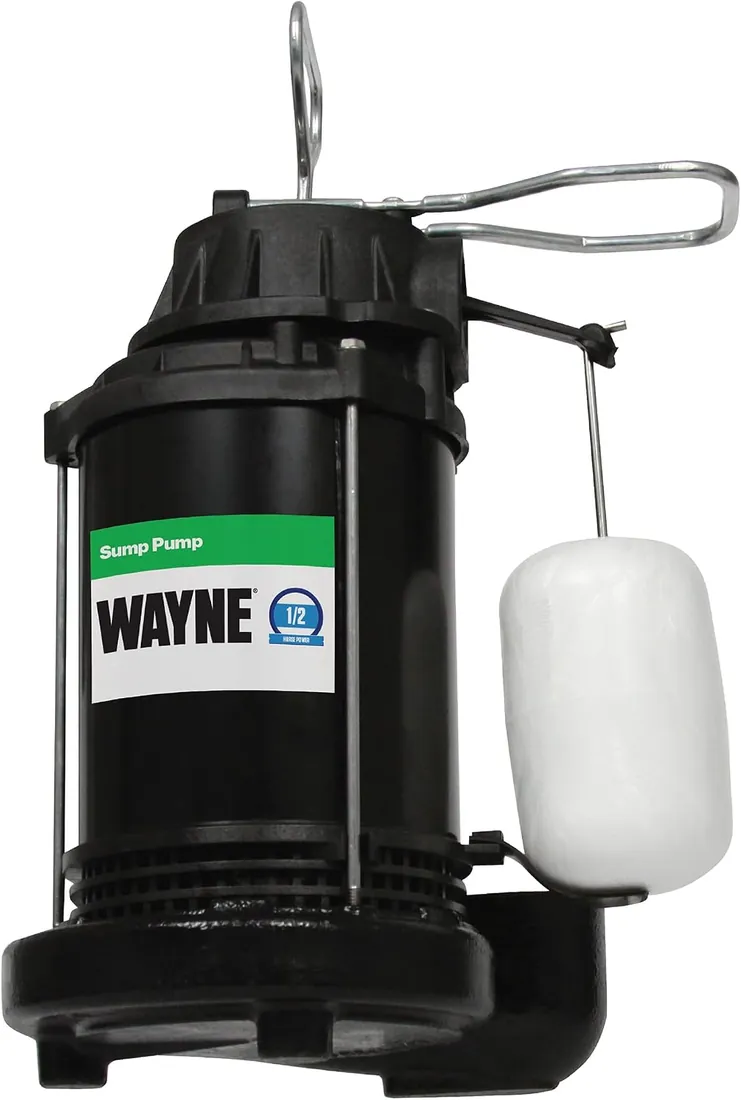
Wayne CDU800 Sump Pump
1/2 HP step up for deeper basements and longer runs.
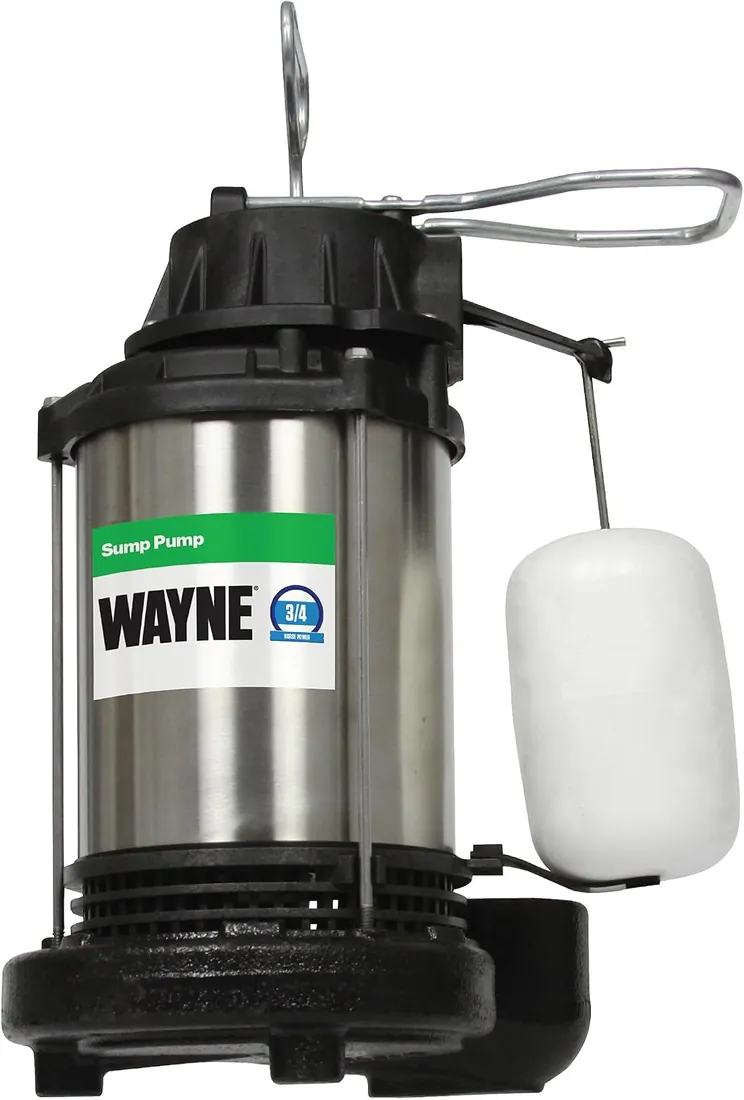
Wayne CDU980E Sump Pump
3/4 HP model that still moves 3,500 GPH at a 20 ft lift.
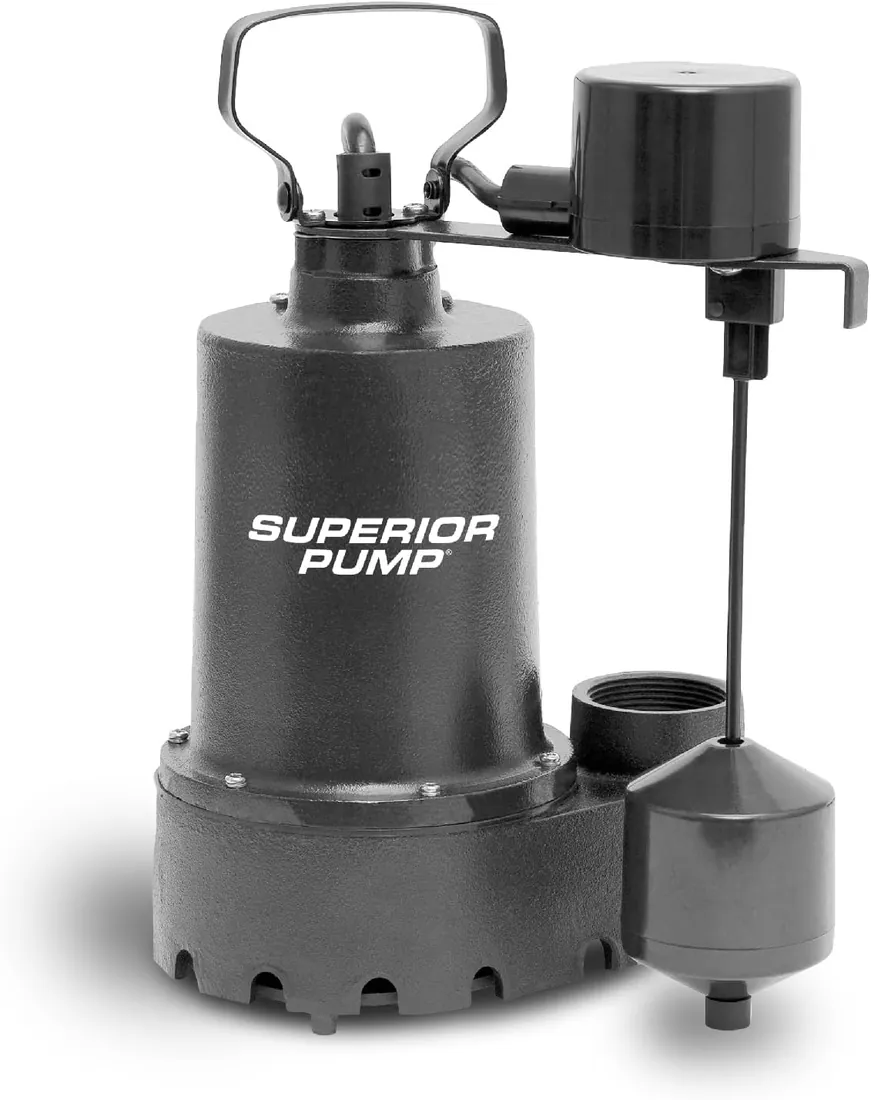
Superior Pump 92341 Cast Iron Sump Pump
1/3 HP cast iron pump with a piggyback vertical float.
Questions readers ask
What size sump pump do I need for a basement?
For most basements with a vertical lift under about ten feet and normal inflow, a 1/3 HP pump is enough. Choose 1/2 HP or more if the lift is higher, the run is long or the pit fills fast in storms. Always confirm flow at your head on the maker chart.
How many gallons per minute does a 1/3 HP sump pump move?
It depends on the model and lift. Wayne's 1/3 HP CDU790 is rated at 4,600 GPH with no lift and 3,060 GPH at 10 ft; Superior's 92341 is rated at 2,760 GPH and 1,800 GPH at the same points. Divide by sixty for gallons per minute.
What size discharge pipe does a sump pump need?
Use at least the size of the pump's outlet, which is 1-1/2 in on most house sump pumps. Liberty notes that long runs may need a larger pipe to cut friction, and no maker allows reducing below the outlet size.