If the water stays within about 25 ft of the pump, a shallow well jet pump above ground is simplest. From there to about 90 ft, a convertible jet with an ejector in the well works, as on Wayne's CWS range. For deeper water, or a 4 in drilled well where quiet, prime-free operation matters, a submersible pump in the well is the usual choice.
Depth to water decides the type
A pump at the surface lifts water by suction, and suction has a physical ceiling. Wayne and Flotec both put the practical limit for shallow well jet pumps at 25 ft from pump to water. That figure is the lowest level the water reaches while the pump runs, not the static level you measure after it has rested.
Below that, the pump has to push rather than pull. A deep well jet does it by sending part of its flow down one pipe to an ejector in the well, which drives water up the second pipe. A submersible does it by putting the whole pump at the bottom of the drop pipe. The table sums up the ranges in the makers' own literature.
| Type | Where it sits | Depth to water | Example |
|---|---|---|---|
| Shallow well jet | Above ground | Up to 25 ft | Wayne SWS50, Red Lion RJS-50-PREM |
| Convertible jet | Above ground, ejector in well | Up to 90 ft | Wayne CWS50, CWS75 |
| 4 in submersible | In a 4 in or larger well | To 250 ft (Red Lion RL) | Red Lion RL12G05-3W2V |
| 4 in submersible | In a 4 in or larger well | To 300 ft (Flotec larger models) | Flotec FP2222 |
Figures: Wayne SWS shallow well jet pump manual 640002W-001 G; Wayne CWS convertible jet pump manual 640003W-001 E; Red Lion RL Series 4 in submersible well pump specifications; Flotec 2-wire 4 in submersible well pump sell sheet.
Jet pumps: easy access, but they must stay primed
A jet pump lives in the basement or a pump house, so the motor, seal and pressure switch are all within reach. Seals and impellers can be changed on the bench; Red Lion's RJS manual walks through a seal replacement. The cost of that convenience is priming. The pump and suction pipe must be full of water, and a single leaking joint lets air in and stops the flow. Red Lion's guide lists air leaks in the suction line, a faulty foot valve and a well drawn down too far as the reasons a jet pump loses prime.
A convertible jet such as the Wayne CWS50 works in both setups. Wayne's manual calls for two pipes down a 4 in or larger drilled well, with the ejector 10 to 20 ft below the lowest water level, and offers a bolt-on jet to convert it back to shallow well use where water is 25 ft or less.
Submersibles: quiet and prime-free, but in the well
A submersible pump pushes water up from below, so it never needs priming and makes almost no noise in the house. Red Lion's RL series fits 4 in and larger drilled wells to 250 ft, with a built-in suction screen and check valve, and Flotec's 2-wire pumps reach 300 ft in their larger sizes.
The trade-off is access. Any repair means pulling the pump and pipe, and the motor's electrical health can only be judged from the surface. Installation depth matters too: Flotec sets its pumps 15 to 20 ft below the lowest pumping level and at least 5 ft above the bottom so sand is not drawn in. Pumps like the Flotec FP2212 are 2-wire, with no control box, while 3-wire models put the starting parts in a box on the wall.
Side by side: what each choice means for an owner
For a lake, spring or driven point well with water close to the surface, a shallow well jet is the simple answer and keeps the pump where you can see it. For a drilled well where water sits deeper but within the convertible range, a convertible jet avoids pulling pipe for service but adds a second pipe and an ejector to keep clean. For a deep or low-yield drilled well, a submersible is usually more efficient and stays primed by design.
Watch the well's behavior in dry seasons. Flotec's troubleshooting notes that if the water level falls past 25 ft, a shallow well setup will stop delivering and a deep well jet is needed. Red Lion's submersible guide suggests throttling the discharge so it does not exceed the well's recovery rate when a low-producing well draws down.
- Measure depth to water while the pump has been running.
- Within 25 ft: a shallow well jet pump.
- Deeper but within the convertible range: a convertible jet.
- Deeper still, or 4 in drilled casing: a submersible.
The parts every type shares
Whichever pump you choose, it feeds a pressure tank and is controlled by a pressure switch. Wayne's CWS pumps come with a 30/50 switch, and the tank precharge should be 2 psi below cut-in, so 28 psi. Red Lion's jet pump manual adds that a check valve should never be installed between a jet pump and its tank. A relief valve protects the system from a switch that fails to open.
For picks in each category, see the shallow well jet pump list and the deep well submersible list.
Common mistakes
- Sizing a jet pump on static water level instead of the level while pumping.
- Buying a shallow well pump for water that drops past 25 ft in summer.
- Putting a submersible within 5 ft of the well bottom.
- Fitting a check valve between a jet pump and its pressure tank.
- Choosing horsepower without reading flow at your actual depth.
Products that fit
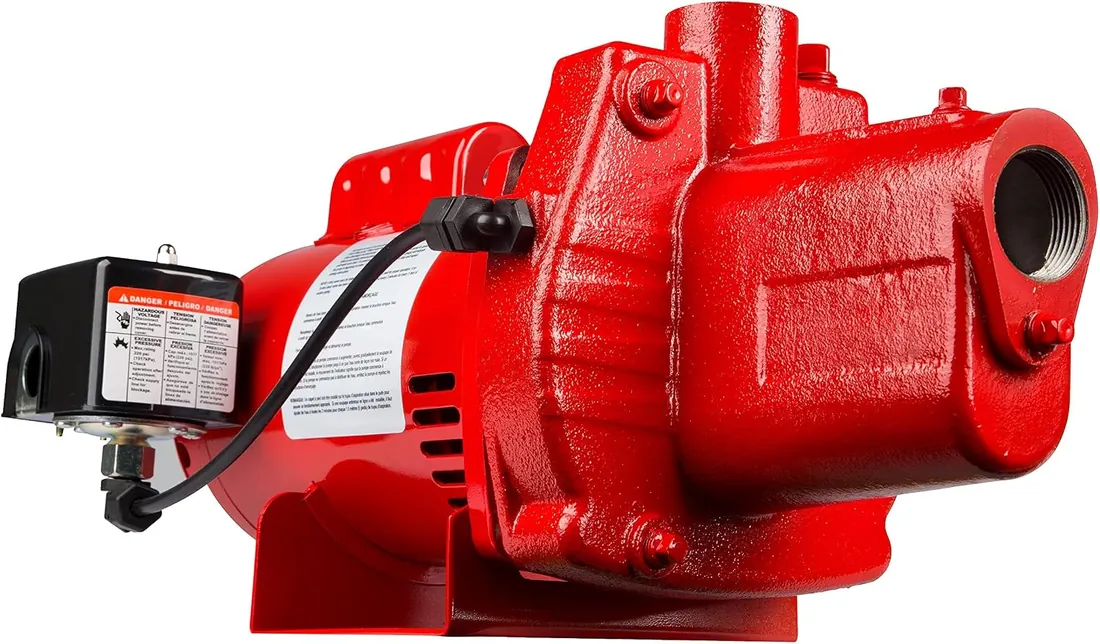
Red Lion RJS-50-PREM Shallow Well Jet Pump
Shallow well jet pump for water within 25 ft of the pump, serviced above ground.
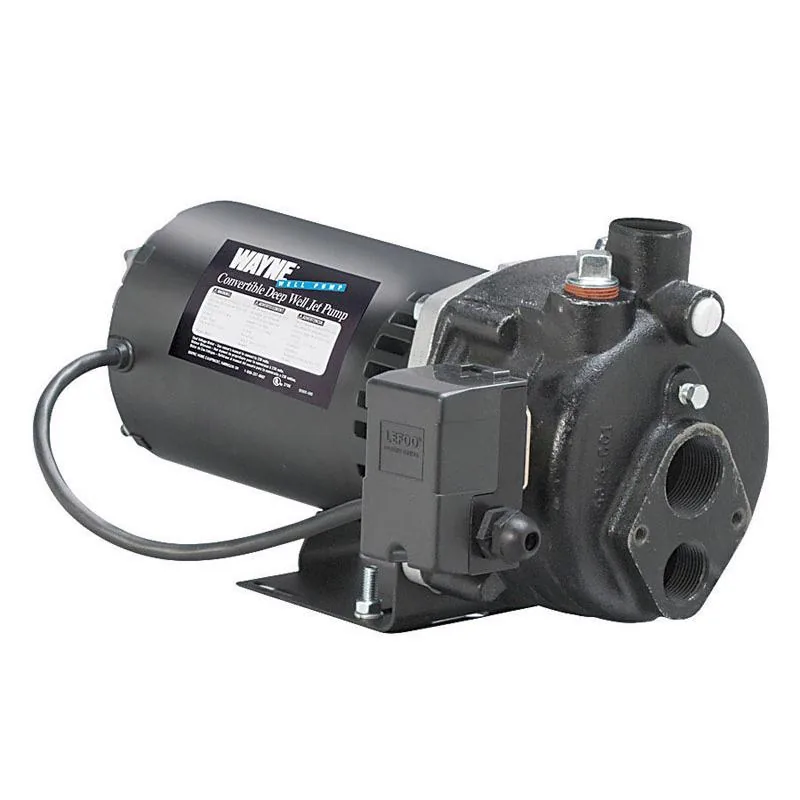
Wayne CWS50 Convertible Jet Well Pump
Convertible jet rated by Wayne for wells up to 90 ft deep with an ejector.

Flotec FP2222 3/4 HP Deep Well Submersible Pump
3/4 HP 2-wire submersible for deep drilled wells with 4 in casing.

Red Lion RL12G05-3W2V Deep Well Submersible Pump
1/2 HP 3-wire submersible from Red Lion's RL series, with control box.
Questions readers ask
What is the difference between a jet pump and a submersible pump?
A jet pump sits above ground and draws or drives water up using suction and an ejector; it must be primed. A submersible sits in the well and pushes water up, needs no priming and is quieter, but must be pulled for service.
How deep can a shallow well pump pull water?
About 25 ft from the pump to the water while pumping, according to Wayne and Flotec. Below that, use a deep well jet or a submersible, and measure in a dry season when the water table is at its lowest.
Is a submersible pump better than a jet pump?
Not always. For deep drilled wells it is usually the better choice. For shallow water, a jet pump is simpler to reach and repair. The depth to water and the casing size decide it.
Can a jet pump be used on a deep well?
A convertible jet can, with an ejector and two pipes in the well. Wayne rates its CWS pumps for wells up to 90 ft and requires a 4 in or larger drilled casing for the two-pipe jet.