Quick verdict
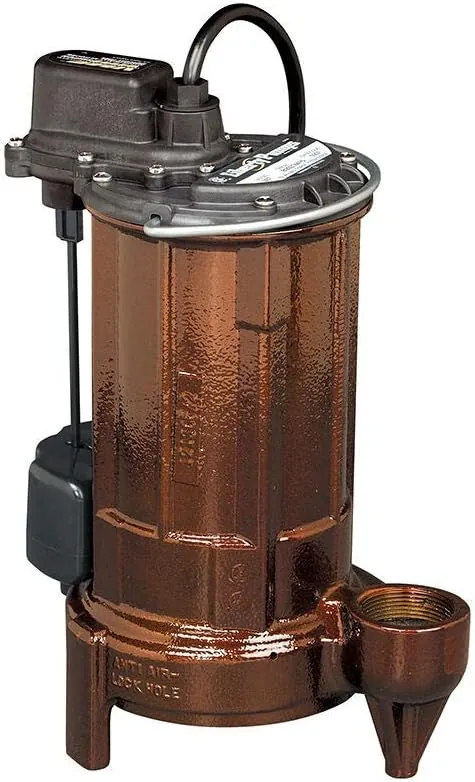
The 287 is the step up from Liberty's 1/3 HP 257 for a house where the discharge climbs high or storms keep the pit busy. It keeps the narrow-pit vertical float, adds a one-piece class 25 iron body, a carbon ceramic seal and 3/4 in solids handling, and reaches 37 ft before flow stops. It draws 8 A, so it wants a circuit of its own, and the float levels are fixed.
Who it fits, and who should skip it
A good fit if
- Water must rise a full storey or more to leave the house, plus a long horizontal run.
- Your pit is as narrow as 10 in but heavy rain fills it quickly.
- You want ball bearings and a carbon ceramic shaft seal rather than a lip seal.
Look elsewhere if
- You need adjustable on and off levels; the 283 uses a tethered float instead.
- The pit is short on depth; the pump stands 13 in tall.
Specifications
Motor
| Horsepower | 1/2 HP |
|---|---|
| Voltage | 115 V, single phase, 60 Hz (287HV: 208-230 V) |
| Amps | 8.0 A full load, 23 A locked rotor; 287HV 4.0 A |
| Motor type | Oil-filled PSC, class B winding, 3450 RPM, thermal overload at 105 °C |
Figures: Liberty Pumps 280-Series engineering specifications 280_P1; Liberty Pumps 280-Series sales literature LLIT002000.
Performance
| Max flow | 62 GPM at 5 ft of total head |
|---|---|
| Max head | 37 ft shut-off head |
Figures: Liberty Pumps 280-Series engineering specifications 280_P1.
Switch
| Switch type | Vertical magnetic float (VMF), not adjustable |
|---|---|
| On / off levels | On at 9.5 in, off at 4 in |
Figures: Liberty Pumps 280-Series sales literature LLIT002000; Liberty Pumps installation manual 7035000R, dewatering and effluent pumps.
Build
| Discharge | 1-1/2 in NPT |
|---|---|
| Solids handling | 3/4 in, vortex impeller in engineered polymer |
| Construction | One-piece class 25 cast iron housing and volute, stainless shaft and hardware |
| Seal and bearings | Carbon ceramic shaft seal; upper and lower ball bearings |
| Minimum sump diameter | 10 in (283 and 281 need 14 in) |
| Size and weight | 13 in tall, 10 in wide; 29 lb on the sales sheet, 30 lb on the spec sheet |
| Power cord | 10 ft SJTW quick-connect; 25 ft as 287-2 |
| Max liquid temperature | 140 °F intermittent, 104 °F continuous |
| Listings | SSPMA, cCSAus |
| Warranty | 3-year limited |
Figures: Liberty Pumps 280-Series engineering specifications 280_P1; Liberty Pumps 280-Series sales literature LLIT002000; Liberty Pumps installation manual 7035000R, dewatering and effluent pumps.
Versions
The 287 shares its motor and body with the rest of Liberty's 280-Series; the switch and cord set the model number.
| Version | Part number | What differs | Listing |
|---|---|---|---|
| 287, vertical magnetic float, 115 V | 287 | 10 ft cord, 8.0 A | View on Amazon |
| 287-2, vertical magnetic float, 115 V | 287-2 | 25 ft cord | Not linked |
| 287HV, vertical magnetic float, 208-230 V | 287HV | 4.0 A, 10 ft cord; 287HV-2 adds a 25 ft cord | Not linked |
| 283, wide-angle piggyback float, 115 V | 283 | Tethered float, on 13 in and off 7 in from the factory, adjustable; needs a 14 in pit | Not linked |
| 280, manual, 115 V | 280 | No switch, for a control panel or external float | Not linked |
Figures: Liberty Pumps 280-Series engineering specifications 280_P1; Liberty Pumps 280-Series sales literature LLIT002000; Amazon listing B000LE3SZ4, Liberty Pumps 287.
Installation and setup
Liberty's installation manual 7035000R asks for a sump at least 18 in deep and, for the 287, at least 10 in across, while noting a wider basin gives longer cycles and less switch wear. Stand the pump on a hard, level base; The Brick platform, part 4445000, lifts it 2-1/2 in clear of stones and silt.
The 1-1/2 in NPT outlet takes Schedule 40 PVC. Fit a check valve, then a gate valve for servicing, and keep the run as short and straight as the house allows, since every elbow adds friction head. An air-bleed hole of 1/8 in drilled in the pipe just above the pump helps it prime after an airlock. Give it a dedicated, grounded circuit sized for its 8 A draw; the cord plugs in directly, never through an extension.
Switch and sizing notes
The magnetic float switches the motor on when water reaches 9.5 in and off at 4 in, and those levels cannot be changed. That short differential keeps the pit low but means frequent starts in a narrow basin, which is why Liberty says not to use VMF models for effluent work. If you need a longer cycle, the 283 tethers its float and can be adjusted.
For sizing, the maker's spec sheet gives two firm points: 62 GPM at 5 ft and no flow at 37 ft. Everything between is drawn as a curve, so read your own total head against that graphic. The sizing guide walks through adding vertical lift and pipe friction, and our list of larger sump pumps compares the 287 with other 1/2 HP choices.
Ownership and maintenance
The motor runs in oil with permanently lubricated ball bearings, and the cord detaches at a sealed plate, so a damaged cord can be replaced without opening the motor. Each month, pour in water until the float lifts and the pump empties the pit. Each quarter, check the float rod for free travel, look over the check valve, and clear stones from the stainless bottom screen.
Liberty's limited warranty covers the pump for three years from the purchase date, provided it has not been taken apart in the field or run on water hotter than its rating.
Pros and cons
Pros
- 37 ft shut-off head, far beyond the 1/3 HP models.
- Passes 3/4 in solids through a vortex impeller.
- Vertical float fits a 10 in pit.
- Ball bearings and a carbon ceramic seal.
Cons
- Fixed float levels with a short cycle.
- 8 A draw needs a circuit of its own.
- Flow between 5 ft and shut-off is shown only on a curve.
Alternatives worth comparing
Compared with and featured in
Final verdict
The 287 earns its place where lift or inflow pushes past what a 1/3 HP pump can handle but the pit is still narrow. Accept the fixed, short float cycle and give it its own circuit, and it covers almost any basement discharge height.
Where to buy
Each button opens this exact model's listing. We may earn a commission on tracked links; it never changes what we publish. Disclosure
Questions buyers ask
How much flow does the Liberty 287 move?
Liberty's engineering specification lists a maximum of 62 GPM at 5 ft of total dynamic head and a shut-off head of 37 ft. Some retail listings quote 75 GPM; the maker's own figure is the one to size from, and anything between those two points must be read from the curve.
Can I adjust the switch on the 287?
No. The vertical magnetic float is factory set to start at 9.5 in and stop at 4 in, and the manual lists it among the non-adjustable models. If you want to tune the cycle, the 283 uses the same pump with a tethered piggyback float that can be shortened or lengthened.
What is the difference between the 287 and 257?
Both are Liberty cast iron pumps with vertical floats. The 287 has a 1/2 HP motor, 3/4 in solids handling, ball bearings with a carbon ceramic seal and 37 ft of head. The 257 is 1/3 HP with 1/2 in solids and 23 ft of head.
Does the 287 need a check valve?
Yes. Liberty calls for a check valve on the discharge to stop the column of water falling back after each cycle, plus a gate valve and union so the valve and pump can be removed. Without one the pump re-pumps the same water and cycles far more often.