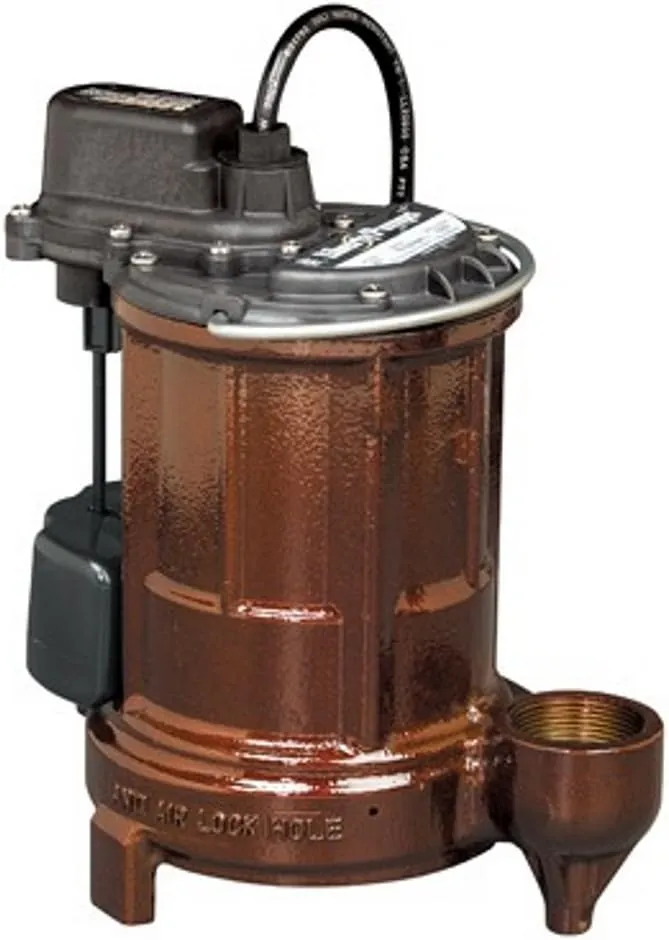
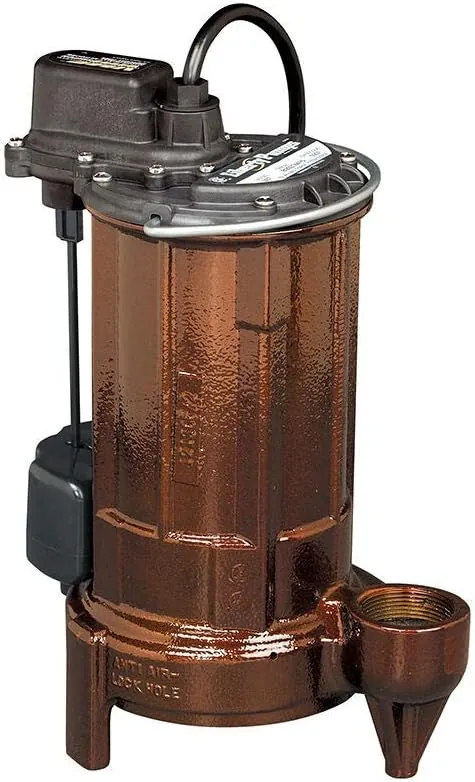
Choose the Liberty 257 when the discharge climbs a modest height, the pit is small, and you want the lighter, lower-current pump that starts and stops sooner.
Choose the Liberty 287 when the pipe climbs high or runs long, storms bring water in fast, or debris in the pit calls for a 3/4 in solids passage.
Key specifications
| Specification | Liberty Pumps 257 Sump Pump | Liberty Pumps 287 Sump Pump |
|---|---|---|
| Horsepower | 1/3 hp | 1/2 hp |
| Running amps at 115 V | 5.2 A (8 A locked rotor) | 8.0 A (23 A locked rotor) |
| Motor | Split capacitor, 3450 RPM | Split capacitor, 3450 RPM |
| Max head | 21 ft (retail listing figure) | Heads to 37 ft (280-Series brochure) |
| Max flow | 50 gpm (retail listing figure) | Flow rates to 68 GPM (280-Series brochure) |
| Flow at a given lift | Curve published as a graphic only | Curve published as a graphic only |
| Switch levels | On 7 in, off 4 in | On 9.5 in, off 4 in |
| Solids passed | 1/2 in | 3/4 in |
| Shaft seal | Engineered double lip seal | Carbon and ceramic |
| Height | 10-1/2 in | 13 in |
| Weight | 21 lb | 29 lb |
| Smallest basin | 10 in diameter | 10 in diameter |
| 230 V version | 257HV, 2.6 A | 287HV, 208-230 V, 4.0 A |
| Warranty | 3-year limited | 3-year limited |
Figures: Liberty Pumps 250-Series engineering specification 250_P1 R04/2025; Liberty Pumps 280-Series engineering specification R04/2025; Liberty Pumps 250-Series sales literature LLIT002500; Liberty Pumps 280-Series sales literature LLIT002000; Amazon listing for Liberty Pumps 257; Liberty Pumps sump pump brochure; Liberty Pumps installation manual 7035000R (250, 280 and 290 series).
Scorecard
| Criterion | Edge | Why |
|---|---|---|
| Highest lift | Liberty Pumps 287 Sump Pump | Liberty's brochure gives the 280-Series heads to 37 ft; the 257 listing tops out at 21 ft. |
| Running current | Liberty Pumps 257 Sump Pump | The 257 draws 5.2 A at 115 V against 8.0 A for the 287, and far less at start-up. |
| Debris tolerance | Liberty Pumps 287 Sump Pump | The 287 passes 3/4 in solids and adds a removable stainless bottom screen. |
| Size and weight | Liberty Pumps 257 Sump Pump | At 10-1/2 in tall and 21 lb, the 257 is shorter and eight pounds lighter than the 29 lb 287. |
| Narrow pits | Even | Both magnetic-float models are approved for basins as small as 10 in across. |
The same design, scaled up
Liberty describes the 280-Series as its classic 1/3 hp cast iron pump with more horsepower added. The 287 keeps the 257's one-piece class 25 cast iron body, quick-connect cord, stainless shaft and hardware and the vertical magnetic float, then fits a 1/2 hp split capacitor motor and a larger hydraulic end.
That means the ownership experience is familiar. Both pumps plug in, both use a non-adjustable magnetic float, both fit a pit as small as 10 in across and both carry Liberty's three-year limited warranty. The differences are capacity, current, solids handling and physical size.
How much higher the 287 can push
Liberty prints both curves only as graphics, so maker figures for flow at a particular lift are not available in text. The 280-Series brochure gives the family heads to 37 ft and flow rates to 68 GPM. The 257's retail listing gives 50 gpm and 21 ft as maximums.
Read together, the 287 can push water roughly 16 ft higher before stalling. In a house where the discharge rises through a finished ceiling, crosses a long basement or exits uphill, that extra head is the difference between a pump that keeps pace in a storm and one that runs and runs without catching up. Where the lift is short, the 257 already has margin and the 287's extra muscle mainly shortens cycles. The sizing calculator estimates your total head.
Current, start-up and backup power
The 257 draws 5.2 A running and 8 A locked rotor at 115 V. The 287 draws 8.0 A running and 23 A locked rotor. Both are comfortable on an ordinary household circuit, and Liberty recommends a dedicated one for either.
The start-up figure matters if you plan to run the pump from a generator or an inverter during an outage. A brief 23 A surge is a heavier load than the 257's 8 A, so check the backup's surge rating before you upsize. The 230 V versions halve the current: 2.6 A for the 257HV and 4.0 A for the 287HV.
Switch levels and cycle length
According to the current installation manual, the 257 starts at 7 in and stops at 4 in, while the 287 starts at 9.5 in and stops at 4 in. Neither level is adjustable on these magnetic-float models; other differentials need a tethered-switch version from the same series.
The higher start on the 287 removes more water each time it runs, which helps a stronger pump avoid short cycling. It also lets the water stand higher before the pump reacts, so check that 9.5 in stays below the inlet pipe in your pit. Our basin and cycle guide explains how start level and pit width set the number of starts per hour.
Solids, seals and screen
The 257's vortex impeller passes 1/2 in solids. The 287 opens that to 3/4 in and adds a removable stainless steel bottom screen, which makes it the better pump for an older pit that sheds gravel or concrete fragments.
The shaft seals differ as well. Liberty fits the 257 with an engineered double lip seal and the 287 with a carbon and ceramic seal, the type more often used on larger pumps. Both motors run in oil on upper and lower ball bearings with thermal overload protection.
Height, weight and fitting
The 287 is 13 in tall and 29 lb, against 10-1/2 in and 21 lb for the 257. In a shallow pit, the extra height can leave the float rod close to the lid, so measure from the pit floor to the underside of the cover before you order.
Both use a 1-1/2 in discharge, so the existing pipe and check valve normally carry over when you upsize. Drill or clear a small anti-airlock hole low on the discharge, as Liberty suggests, and keep the receipt for the three-year warranty.
One last check is worth the minute it takes. Lower the new pump in on its discharge pipe, make sure the float rod stands vertical and clear of the basin wall, then fill the pit with a hose and watch a full cycle. A pump that starts, empties the basin and stops cleanly on its own is set; one that rattles against the wall or chatters at the start level needs repositioning before the next storm.
Who each one fits
The Liberty Pumps 257 Sump Pump fits if
- The discharge climbs a modest height through the rim joist and runs only a short way outside.
- The pit is shallow and a 13 in tall pump would crowd the float rod against the lid.
- You want the lowest running and start-up current for generator or inverter backup.
- The water is clean groundwater and a 1/2 in solids rating is plenty for what reaches the pit.
The Liberty Pumps 287 Sump Pump fits if
- The pipe climbs through a finished ceiling, crosses the basement or exits far uphill.
- In heavy storms the existing 1/3 hp pump runs constantly without gaining on the water.
- The pit sheds gravel or concrete chips that need a 3/4 in passage and a bottom screen.
- You want longer, calmer cycles from the 9.5 in start level in a deep basin.
Questions readers ask
Is the Liberty 287 just a stronger 257?
Largely, yes. Both share the one-piece cast iron body, magnetic float and quick-connect cord. The 287 adds a 1/2 hp motor, heads to 37 ft per the series brochure, a 3/4 in solids passage, a carbon and ceramic seal, and more height and weight.
Can I upgrade from a 257 to a 287 without new plumbing?
Usually. Both use a 1-1/2 in discharge and fit a 10 in basin. Check that the 13 in tall pump and its 9.5 in start level suit your pit depth and inlet height, and that the circuit and any backup power can handle 8.0 A running.
Does the 287 cost more to run?
It draws 8.0 A against 5.2 A while running, but it also moves more water per minute and finishes each cycle sooner. At a high lift the 287 can even use less energy per storm because the 257 would run much longer.
Where can I see flow at my exact lift?
Liberty prints the 250 and 280 curves only as graphics in its sales literature and spec sheets. Read your total head on those charts, or ask Liberty for the figure, rather than relying on maximum flow numbers alone.
Final verdict
Let total head decide between these two. For a short lift and a small or shallow pit, the 257 does the job with less current, less weight and a lower start level. When the pipe climbs high, runs long or the pit sheds debris, the 287's extra head, 3/4 in solids passage and longer cycles justify the larger, heavier pump.