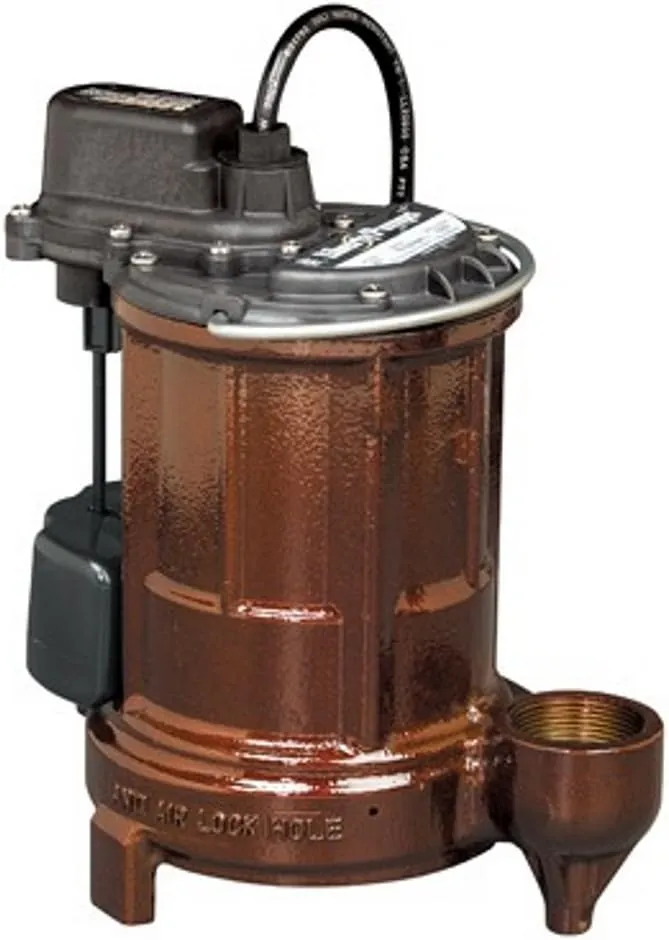
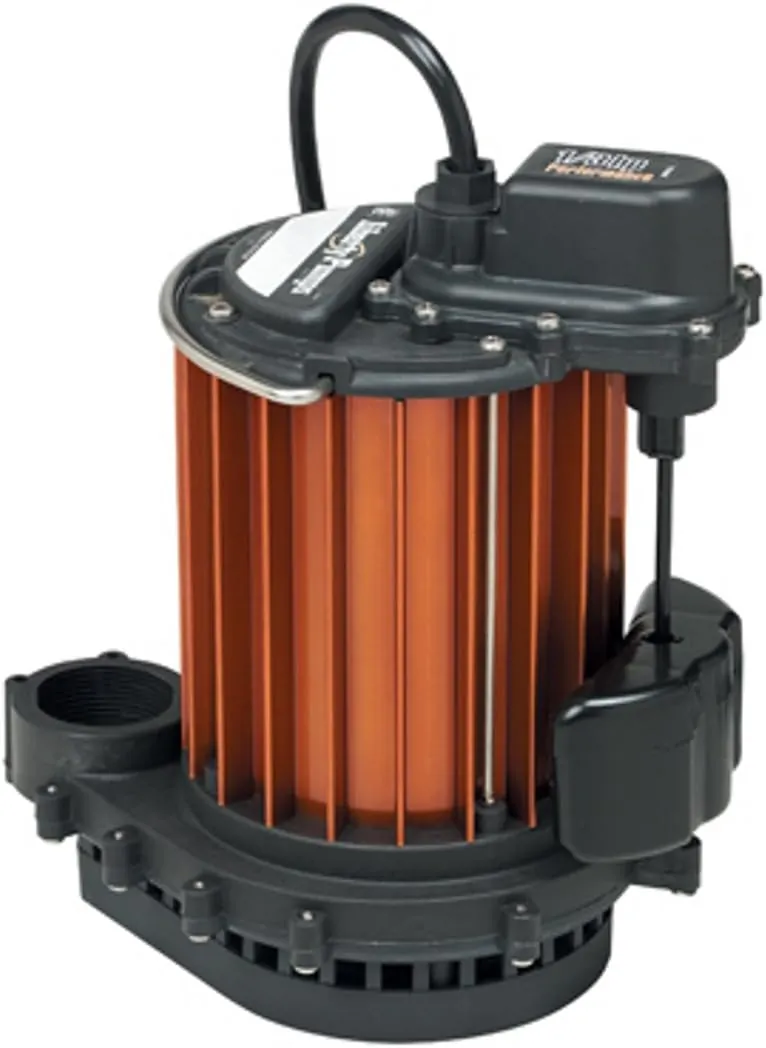
Choose the Liberty 257 when you want a heavy one-piece cast iron body, a slightly larger solids passage and published switch levels you can plan the pit around.
Choose the Liberty 237 when weight matters, you want the finned aluminum housing that Liberty says cools the motor better, or the pump must pull water lower in a shallow pit.
Key specifications
| Specification | Liberty Pumps 257 Sump Pump | Liberty Pumps 237 Sump Pump |
|---|---|---|
| Horsepower | 1/3 hp | 1/3 hp |
| Motor | Split capacitor, 3450 RPM, 115 V | Split capacitor, 3450 RPM, 115 V |
| Running amps | 5.2 A | 5.2 A |
| Housing | One-piece class 25 cast iron | Powder-coated finned aluminum with polypropylene |
| Impeller | Vortex, engineered polymer | Vortex, high-temp engineered thermoplastic |
| Solids passed | 1/2 in | 3/8 in |
| Switch | Vertical magnetic float, on 7 in, off 4 in | Vertical magnetic float, levels not stated in text |
| Max flow and head | 50 gpm, 21 ft (retail listing figures) | 44 gpm, 21 ft (retail listing figures) |
| Smallest basin | 10 in diameter | 10 in diameter |
| Weight | 21 lb | 11 lb |
| Liquid temperature | 104°F continuous, 140°F intermittent | 104°F continuous, 140°F intermittent |
| Cord | 10 ft (25 ft as 257-2) | 10 ft (25 ft as 237-2) |
| 230 V version | 257HV, 2.6 A | 237HV, 2.6 A |
| Warranty | 3-year limited | 3-year limited |
Figures: Liberty Pumps 250-Series engineering specification 250_P1 R04/2025; Liberty Pumps 230-Series sales literature LLIT002300; Liberty Pumps 250-Series sales literature LLIT002500; Liberty Pumps installation manual 7035000R (250, 280 and 290 series); Amazon listing for Liberty Pumps 257; Amazon listing for Liberty Pumps 237; Liberty Pumps installation manual 7108000L (230 and 450 series).
Scorecard
| Criterion | Edge | Why |
|---|---|---|
| Weight to handle | Liberty Pumps 237 Sump Pump | At 11 lb the aluminum 237 is about half the weight of the 21 lb cast iron 257. |
| Solids it can pass | Liberty Pumps 257 Sump Pump | Liberty rates the 257 for 1/2 in solids and the 237 for 3/8 in, which helps the iron pump in a gritty pit. |
| Motor cooling | Liberty Pumps 237 Sump Pump | Liberty says the finned aluminum housing gives far more cooling capacity than its cast iron bodies. |
| Published switch levels | Liberty Pumps 257 Sump Pump | The current manual lists the 257 at 7 in on and 4 in off; the 237 levels are not printed in text. |
| Running cost | Even | Both motors draw 5.2 A at 115 V, so the electricity used per minute of pumping is the same. |
Two series, one motor
The 257 belongs to Liberty's 250-Series and the 237 to its 230-Series, but the heart of each pump is the same: a 1/3 hp permanent split capacitor motor turning at 3450 RPM and drawing 5.2 A at 115 V, oil-filled and thermally protected. Both come with Liberty's vertical magnetic float, a 1-1/2 in discharge, a 10 ft quick-connect cord and a 230 V option drawing 2.6 A.
So the choice is not about horsepower or running cost. It is about the body wrapped around that motor, the size of the solids it can pass, and how much the whole pump weighs when you lift it out of a wet pit.
Cast iron against finned aluminum
Liberty casts the 257 as one piece of class 25 cast iron, which removes the seal ring between the motor housing and the volute. It is the pump Liberty markets as its rugged classic, and its weight keeps it planted on the pit floor.
The 237 takes the opposite approach. Its motor sits in a deep-finned, powder-coated aluminum housing combined with polypropylene, and Liberty claims those fins give 225 percent more cooling capacity than its cast iron housings. A cooler motor should last longer under frequent cycling. The trade-off is that a thinner aluminum shell is easier to dent if it is dropped, and polypropylene parts do not like rough handling.
Solids, intake and how low it pumps
Both pumps use a vortex impeller that lets debris pass without jamming. The 257's passage takes solids up to 1/2 in, while the 237 is rated for 3/8 in. In a clean liner either is fine; in a pit that collects pea gravel or chips of old concrete, the larger passage gives the iron pump more margin.
The 237 has a trick of its own. Liberty says its removable base lets it pull water down to 1/8 in, which is useful for clearing a flooded floor or a shallow pit once the switch is bypassed. Like the 257, it has an anti-airlock hole in the volute to let trapped air escape so the pump can prime.
Capacity and the missing curve
Liberty prints both performance curves only as graphics, so we cannot quote flow at a given lift from the maker. The retail listings give 50 gpm and 21 ft for the 257 and 44 gpm and 21 ft for the 237. Taken at face value, the iron pump moves a little more water at low lift and the two run out of push at about the same height.
For a typical basement where the pipe climbs through the rim joist and runs a short way outside, either pump is in its comfortable range, and the extra few gallons a minute from the 257 mostly shortens each cycle rather than changing whether the pit keeps up. If your discharge climbs much higher, step up to the 1/2 hp Liberty 287 rather than choosing between these two. The sizing calculator helps you find your total head.
Pit size and switch behavior
Both magnetic-float models may be used in a basin as small as 10 in across, which is the main reason people choose them over Liberty's wide-angle float versions that need 14 in. Liberty still prefers a wider pit for longer cycles and less switch wear.
The current 250-Series manual lists the 257 starting at 7 in and stopping at 4 in, fixed at the factory. The 230-Series manual does not print the 237 levels in text, though it says the water must stay at least 4-1/2 in deep over long periods for cooling when the pump is under external control. If you need exact levels for a shallow pit, ask Liberty before buying the 237.
Warranty and upkeep
Each pump carries Liberty's three-year limited warranty, which asks for a dated sales receipt showing the model and serial number. Keep it with the pit records, because the date on the nameplate is used if the receipt is missing.
Care is identical. Keep the float free of debris, check that the anti-airlock hole is not blocked, and run the pump with a bucket of water before storm season. Liberty's optional stand lifts either pump off the pit floor, and for the bottom-intake 257 in a gritty pit it is a cheap addition that keeps sand away from the impeller.
Who each one fits
The Liberty Pumps 257 Sump Pump fits if
- You want a heavy cast iron body that stays planted and resists knocks.
- The pit collects small stones or concrete chips that need a 1/2 in passage.
- You want the switch levels in writing before setting the inlet height.
- You are replacing an existing 257 and want the same pump back.
The Liberty Pumps 237 Sump Pump fits if
- You will lift the pump out often and want an 11 lb unit.
- The pump cycles a lot and you value the finned housing's extra cooling.
- You sometimes need to pull water down to about 1/8 in on a flat floor.
- The pit is narrow and clean, so a 3/8 in solids rating is enough.
Questions readers ask
Which is better, the Liberty 257 or the 237?
Neither wins outright. The 257 is the tougher cast iron pump with a larger solids passage; the 237 is half the weight with a finned housing that Liberty says runs cooler. Both use the same 1/3 hp motor and magnetic float, so pick on build and pit conditions.
Do they pump the same amount of water?
Close to it. Liberty shows both curves only as graphics. Retail listings give the 257 a 50 gpm maximum and the 237 a 44 gpm maximum, both with a 21 ft ceiling, so at ordinary basement lifts the difference is small.
Will a 237 fit where a 257 was installed?
Usually. Both have a 1-1/2 in discharge and can be used in a basin as small as 10 in across. Check the switch level against the height of your inlet pipe, because the 237 levels are not printed in the manual text.
Does the aluminum 237 corrode?
Liberty powder coats the aluminum housing and uses stainless fasteners and a stainless shaft to resist corrosion. In ordinary groundwater that is enough; in a pit with aggressive water, the thicker cast iron 257 gives more margin if the coating is damaged.
Final verdict
These two are the same Liberty motor and float in different clothes. The cast iron 257 is the sturdier, heavier pump with a bigger solids passage and documented switch levels. The aluminum 237 is light, runs cooler by Liberty's account and pulls water lower in a pinch. For a rough pit choose iron; for frequent handling or a clean, narrow liner, the 237 makes sense.