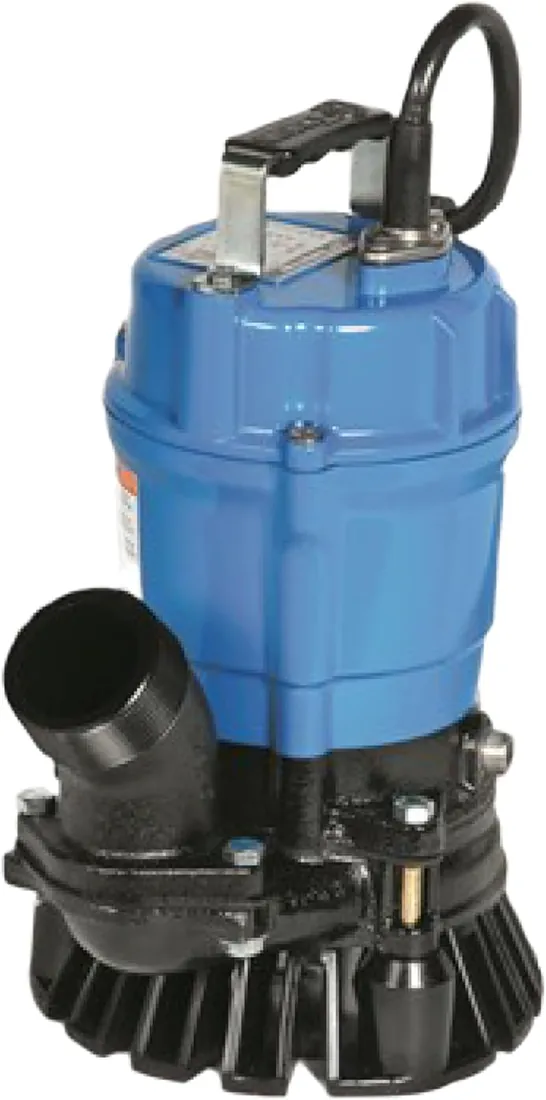
Quick verdict
The HS2.4S is a contractor's pump that also suits homeowners facing muddy floods: its agitator stirs settled sand into suspension so the vortex impeller can pass it, and its double mechanical seal sits in an oil bath. It is heavier and more demanding to own than a plastic utility pump, with oil checks and periodic overhauls. There is no switch on this version, and the water must stay below 104 °F.
Who it fits, and who should skip it
A good fit if
- You pump water carrying sand, mud or grit from excavations, ponds or flooded yards.
- You need a 2 in discharge for lay-flat hose and real volume.
- The pump will see repeated or rental-style use.
- Your lift is well below 39 ft, the maximum head.
Look elsewhere if
- You want a pump that starts and stops itself; look at the HSZ or HSE versions.
- You want a light pump to carry up basement stairs.
- The liquid is oil, sea water or strong acid.
Specifications
Motor
| Horsepower | 0.41 kW (1/2 HP) |
|---|---|
| Voltage | 115 V single phase, capacitor-run (US model) |
| Motor type | Dry submersible induction, 2-pole, insulation class E |
| Motor protection | Built-in miniature protector |
Figures: Tsurumi HS series operation manual B-10244-1; Amazon listing B000PDU9EY.
Performance
| Max flow | 53 GPM (0.200 m³/min) |
|---|---|
| Max head | 39 ft (12 m) |
| Flow at other heads | Not stated in the manual text |
Figures: Tsurumi HS series operation manual B-10244-1.
Switch
| Switch type | None: non-automatic circuit |
|---|
Figures: Tsurumi HS series operation manual B-10244-1.
Build
| Discharge | 50 mm (2 in) hose coupling |
|---|---|
| Impeller | Vortex type with agitator |
| Solids | Up to 0.3 in per the listing |
| Seal and bearings | Double mechanical seal in oil; shielded ball bearings |
| Lubricant | Turbine oil VG32 (non-additive) |
| Liquid | Clean, rain, ground, sand- or mud-carrying water; 0 to 40 °C (32 to 104 °F) |
| Weight | 11.3 kg without cable |
| Power cord | 20 ft per the listing |
| Warranty | 2 years per the listing |
Figures: Tsurumi HS series operation manual B-10244-1; Amazon listing B000PDU9EY.
Versions
Tsurumi's HS manual covers three 1/2 HP versions that differ only in control. Only the plain HS2.4S is linked here.
| Version | Part number | What differs | Listing |
|---|---|---|---|
| HS2.4S, non-automatic | HS2.4S-62 | 0.41 kW, 2 in discharge, no level control | View on Amazon |
| HSZ2.4S, float switch | HSZ2.4S | Automatic operation with floats; same rating | Not linked |
| HSE2.4S, electrode level relay | HSE2.4S | Starts at 165 mm of water; runs on about 1 minute after the level drops | Not linked |
Figures: Tsurumi HS series operation manual B-10244-1; Amazon listing B000PDU9EY.
Installation and setup
Slide your hose fully onto the hose coupling and clamp it; the US model ships without the hose band, so supply your own. Route the hose as straight as you can. Tsurumi warns that a kink at the base traps air in the pump and makes it run dry, and that sharp bends reduce flow or let mud clog it. Keep the hose end above the water surface so water does not siphon back or keep flowing after the pump stops.
Lower the pump by its handle with a rope or chain rated for its weight, never by the cable, and stand it upright. If it could sink into sediment, set it on a concrete block. Tsurumi asks for a dedicated outlet on a circuit with an earth-leakage breaker, supply voltage within 5% of the nameplate, and, on a generator, no other equipment sharing it. Before first use, a megger reading of 20 MΩ or more confirms the insulation.
Switch and sizing notes
The HS2.4S runs on a non-automatic circuit: it pumps as long as it has power. If you need it to start and stop with the water, Tsurumi makes the HSZ2.4S with floats and the HSE2.4S with an electrode level relay that starts at 165 mm and keeps draining for about a minute after the water drops. Never run any of them dry or against a closed valve.
Tsurumi gives two figures for this model: a maximum of 53 GPM and a maximum head of 39 ft. Flow falls to nothing at that head, so plan on well under 53 GPM once your lift and hose length are added. The retail title quotes 39 GPM, which appears to mix up the head figure with flow; rely on the manual.
Ownership and maintenance
After use, wash the pump with tap water, paying special attention to clearing debris from the impeller, then check for damage and loose bolts. The maintenance table covers operating current, insulation resistance of at least 1 MΩ in service, oil inspection and change with turbine oil VG32, and a full overhaul once every 2 to 5 years even if the pump seems fine; seal replacement needs a Tsurumi dealer.
If the pump stays submerged between jobs, run it about once a week; otherwise wash, dry and store it indoors. The retail listing quotes a two-year warranty.
Pros and cons
Pros
- Agitator and vortex impeller handle sand and mud.
- Double mechanical seal in an oil bath.
- 2 in discharge for high-volume hose.
- Float and electrode versions available.
Cons
- No switch on the plain HS2.4S.
- Needs oil checks and periodic overhaul.
- Only two performance figures in the manual.
Alternatives worth comparing
Compared with and featured in
Final verdict
The HS2.4S earns its place where water is dirty and the job is tough, thanks to its agitator, oil-bathed seal and 2 in outlet. For clear water and lighter upkeep, a cast iron or thermoplastic utility pump is the simpler choice.
Where to buy
Each button opens this exact model's listing. We may earn a commission on tracked links; it never changes what we publish. Disclosure
Questions buyers ask
What is the flow rate of the Tsurumi HS2.4S?
Tsurumi's manual lists a maximum capacity of 0.200 m³/min, or 53 GPM, and a maximum head of 39 ft. The retail title shows 39 GPM, which seems to confuse the head figure with flow. Real flow falls as lift and hose length increase.
Can the HS2.4S pump sandy or muddy water?
Yes. Tsurumi lists sand-carrying and mud-carrying water as suitable, and the agitator keeps solids moving into the vortex impeller. If the pump could sink into sediment, stand it on a concrete block to limit wear.
Does the HS2.4S have a float switch?
No, it is the non-automatic version. The HSZ2.4S adds floats for automatic operation, and the HSE2.4S uses an electrode level relay that starts at 165 mm of water. All three share the 0.41 kW motor.
How warm can the water be?
The manual limits the liquid to 0 to 40 °C, which is 32 to 104 °F. Warmer water can damage the pump and its insulation. It is also not for oil, sea water or strong acid.