Use the sealed AGM standby battery your backup maker recommends, sized to fit its battery box: Wayne recommends its 12 V, 75 amp-hour WSB1275 for the ESP25n, and Basement Watchdog pairs its systems with the BW-27AGM. AGM batteries need no water and suit the slow charging these controllers use. Check the battery monthly and replace it when it fails a test or reaches about half its original capacity.
AGM, wet-cell or deep cycle?
Backup sump pumps run on a single 12 V lead-acid battery, and there are three common kinds. Sealed AGM batteries hold their electrolyte in glass mat, need no water and do not spill. Wet-cell batteries need distilled water topped up and vent more gas. Marine or deep-cycle batteries are wet-cell designs built for repeated deep discharge.
Makers lean toward AGM. Wayne's ESP25n manual says the system operates most efficiently with AGM batteries, which cost slightly more but can last longer. Basement Watchdog says its maintenance-free standby batteries outlast automotive and deep-cycle batteries in backup use. Zoeller, by contrast, specifies a marine-type deep-cycle battery for its DC backups. If you use wet cells, Basement Watchdog says to add water every four to six months, and to retire a battery that runs low every few weeks.
| Battery | Type | Rating | Made for |
|---|---|---|---|
| Wayne WSB1275 | Sealed lead-acid, maintenance free | 12 V, 75 Ah | Wayne ESP25n and ESP25 |
| Basement Watchdog BW-27AGM | AGM, maintenance free | Not stated on the data sheet | BWE, BWSP+, CITS-50 and others |
| Zoeller DC backups | Marine deep-cycle | Not stated on the data sheet | Zoeller battery backup systems |
Figures: Wayne WSB1275 battery installation manual 690003-001 B; Wayne ESP25n operating instructions 600005W-001 J; Basement Watchdog maintenance free battery instructions (BW-27AGM); Zoeller product support FAQ.
How big a battery you need
Capacity, in amp-hours, sets runtime. A larger battery keeps the pump going longer, but it has to fit the battery box and the charger has to be able to refill it. Wayne's ESP25n box takes a 12 V AGM battery up to a group 27 frame. Basement Watchdog publishes runtimes with its own battery at a 10% duty cycle: 40 hours for the Big Dog CONNECT, 48 hours for the Special CONNECT and 80 hours for the Emergency, which draws less.
Those figures assume the pump runs a tenth of the time. In a pit that fills fast, runtime falls sharply. The battery backup runtime calculator estimates hours for your own inflow and battery.
Can you use two batteries?
It depends on the system, and makers disagree. Basement Watchdog says its Big Dog CONNECT, Special CONNECT and Big Combo can run two batteries connected in parallel, positive to positive and negative to negative, using its PJC cable, which doubles pumping time. It recommends batteries of the same size and age, each in its own box.
Wayne says the opposite for the ESP25n: batteries are not to be wired in parallel, and the pump is intended for one 12 V battery. Follow the manual for the system you own. If you need more runtime than one battery gives, choose a system built for two, such as the Basement Watchdog Special CONNECT.
Charging: why recharge time matters
After an outage the controller has to refill the battery before the next storm. Basement Watchdog's chargers show how much this varies: the Big Dog's 20 A charger refills a drained battery in about six hours, the Special's 1.6 A charger can take up to three days, and the Emergency's trickle charger several days. A new battery needs about 24 hours to reach full charge before the controller stops reporting it low.
Wayne adds a warning that applies to any lead-acid battery: avoid over-discharge and recharge immediately after use, because a battery left discharged loses capacity through sulphation. If a long outage drains the battery and the charger is slow, a car parts store can charge it quickly, though Basement Watchdog says to disconnect the controller before using an automotive charger.
When to replace the battery
Wayne's battery manual gives the clearest rule: replace the battery when its capacity has fallen to half its original value. Heat shortens that time. Wayne says the usable life is cut in half for every 10 °C rise above 77 °F in standby use, so a battery in a hot utility room ages faster than one in a cool basement. Liberty notes most backup batteries last three to five years, depending on use and conditions.
Test monthly. Wayne's ESP25n procedure is to unplug the charger, check the terminals for corrosion, unplug the main pump and fill the pit until the backup runs, twice. A red light or chirp from the control box means the battery needs attention. Basement Watchdog systems sound an alarm when terminals corrode; clean the posts and rings with a wire brush until shiny, and skip anti-corrosion sprays, which it says can stop the battery charging properly.
- Unplug the charger and the main pump.
- Disconnect the old battery, negative cable first.
- Set the new battery in the box and connect positive, then negative.
- Reattach any fluid sensor as the manual directs.
- Plug the charger back in and allow a full day to charge.
- Run the backup with water in the pit, then restore the main pump.
Matching battery and backup system
Older controllers may not like maintenance-free batteries. Basement Watchdog says systems built before 2014 may give false alarms with one, and that its fluid-sensor wire must be attached to the positive post when an AGM battery is used, or the low-fluid alarm sounds continuously. Wayne's controller has its own charge profile tuned to the battery it recommends.
The safe choice is the maker's matching battery: the Wayne WSB1275 for Wayne systems and the BW-27AGM for Basement Watchdog. A generic 12 V sealed battery of the right size can work, but check the manual for size limits and keep the receipt for warranty claims.
Common mistakes
- Using a car starting battery, which is not built for long, slow discharge.
- Wiring two batteries in parallel on a system whose maker forbids it.
- Spraying anti-corrosion coating on terminals, which can block charging.
- Leaving a drained battery uncharged after an outage.
- Keeping the battery in a hot room, which shortens its life.
Products that fit
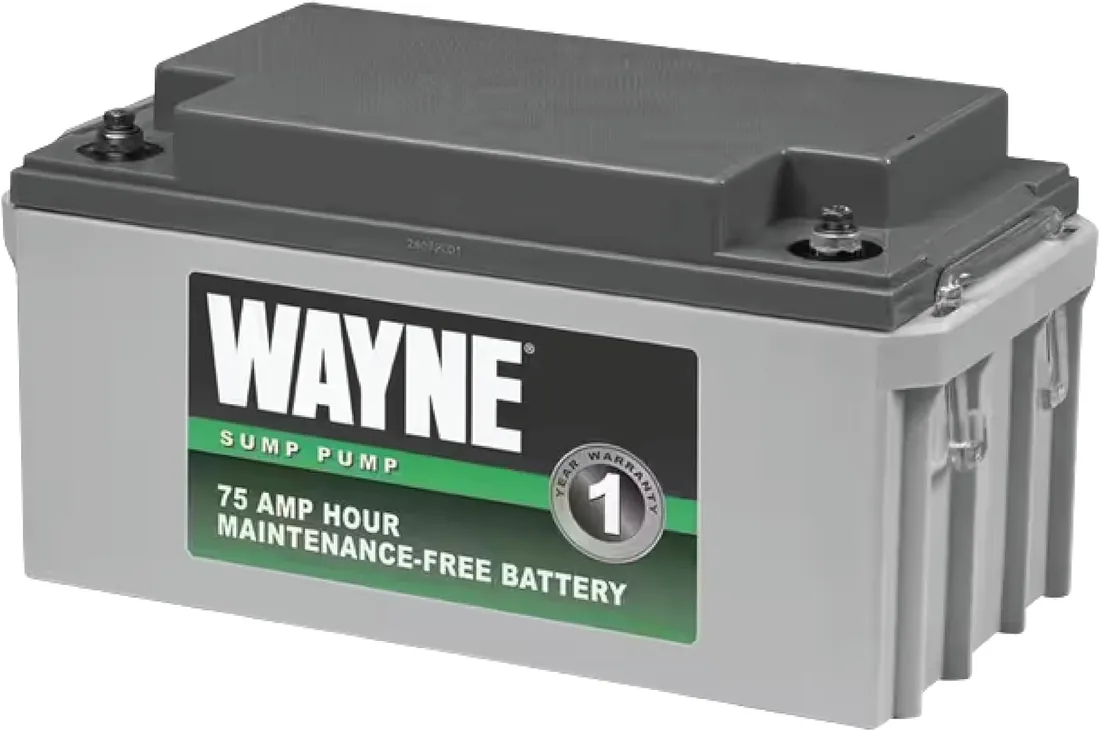
Wayne WSB1275 Standby Battery
Sealed 12 V, 75 Ah battery that Wayne recommends for the ESP25n.
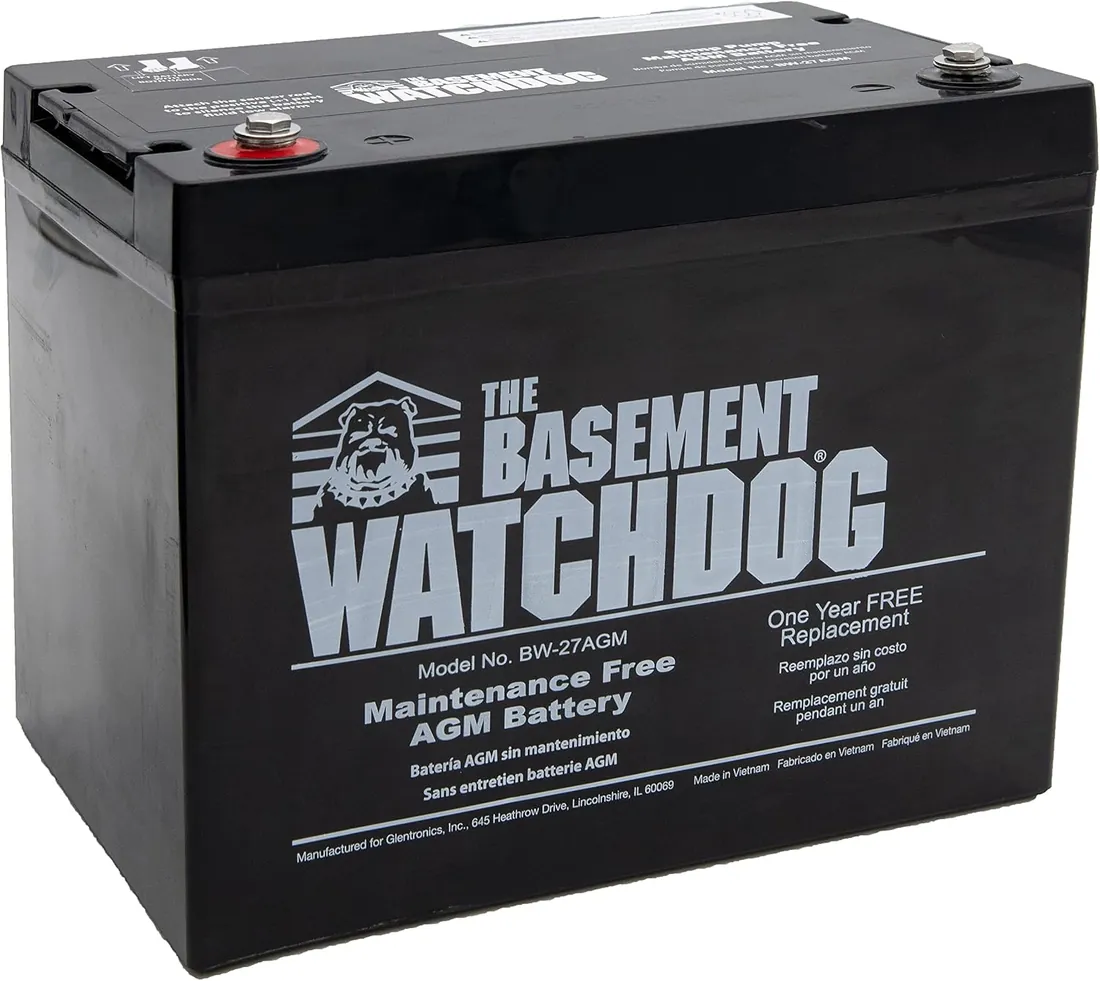
Basement Watchdog BW-27AGM Standby Battery
Maintenance-free AGM battery matched to current Basement Watchdog backup and combo systems.
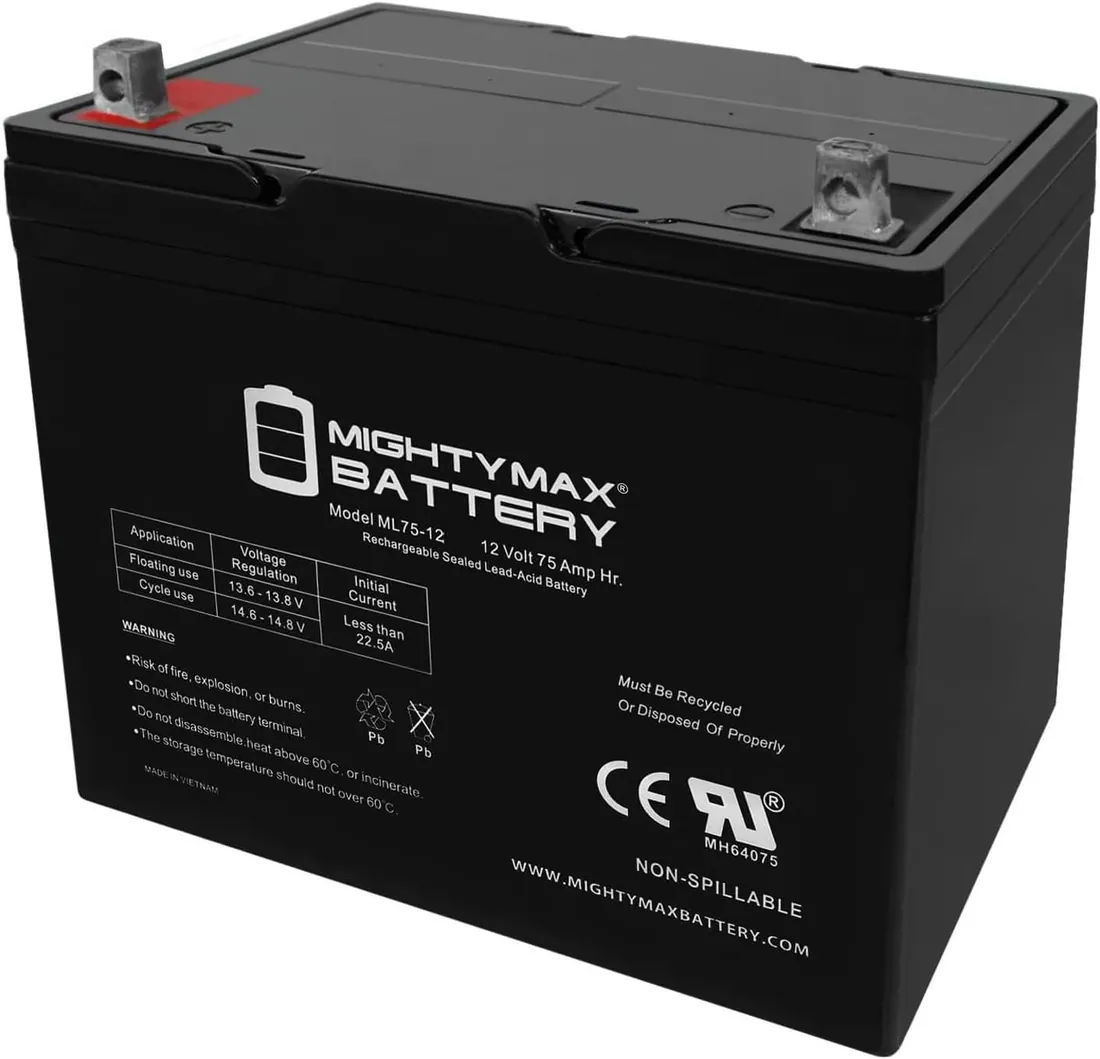
Mighty Max ML75-12 75Ah Battery
Generic 12 V sealed lead-acid battery for systems that accept other brands.
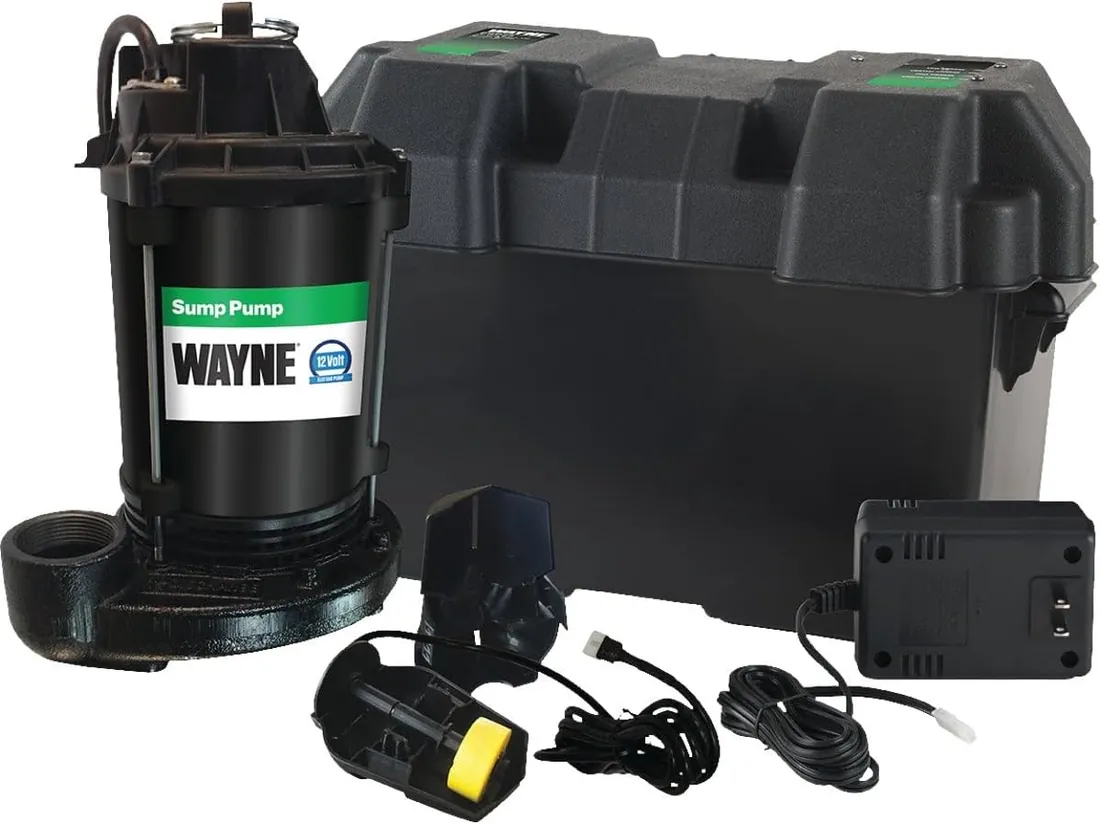
Wayne ESP25n Battery Backup Sump Pump
Backup pump designed around a single AGM battery up to group 27 size.
Questions readers ask
Can I use a regular car battery for a backup sump pump?
It will run the pump, but car batteries are built for short, heavy bursts, not long slow drains. Makers recommend AGM standby or deep-cycle batteries, which survive repeated discharge and last longer in backup duty.
How long does a sump pump backup battery last?
Liberty says most last three to five years. Heat, deep discharges and slow recharging shorten that. Wayne advises replacing a battery once it has lost half its original capacity. Keep the battery cool and recharged.
How do I test my backup sump pump battery?
Unplug the charger and main pump, fill the pit and let the backup run. Wayne's control box shows green for full, yellow for partial and red for discharged or defective. A battery that runs the pump only briefly needs replacing.
Do AGM batteries need maintenance?
No water is needed, but terminals still corrode. Basement Watchdog asks owners to clean the posts and rings with a brush or sandpaper and not to coat them afterwards. Wipe dust off the case too.