Quick verdict
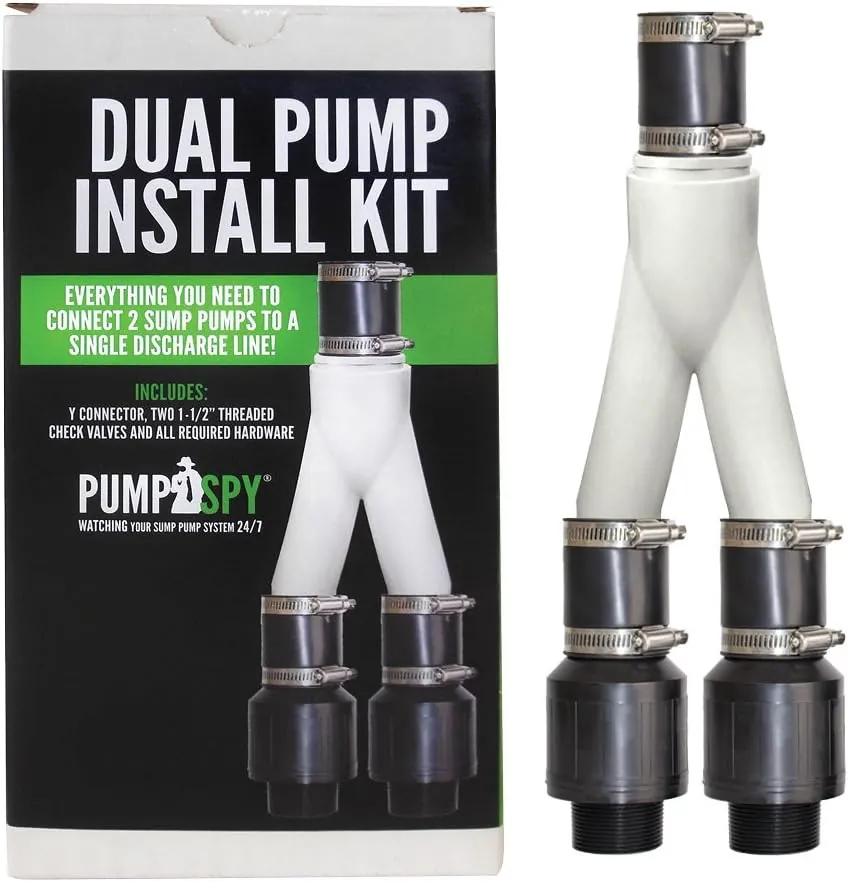
The tidy way to add a second pump, usually a backup, without cutting and gluing a nest of PVC in the pit. Each pump gets its own check valve, so one pump cannot push water back down through the other. It assumes both pumps have standard 1-1/2 in NPT outlets and a pit wide enough for two pumps side by side.
Who it fits, and who should skip it
A good fit if
- You are adding a backup pump beside a primary pump.
- Both pumps have 1-1/2 in NPT discharges.
- You would rather tighten clamps than glue PVC.
Look elsewhere if
- Either pump has a different outlet size.
- The pit is too small for two pumps.
Specifications
Kit
| Contents | Y-connector, two threaded silent check valves, couplings, clamps |
|---|---|
| Check valves | Two, 1-1/2 in threaded, silent type |
| Couplings | Buna-N rubber with stainless steel clamps |
Figures: Amazon listing B0752TKTNF (PumpSpy PSDPKIT1).
Fit
| Pump outlets | Standard 1-1/2 in NPT |
|---|---|
| Joins to | Existing 1-1/2 in discharge line |
Figures: Amazon listing B0752TKTNF (PumpSpy PSDPKIT1).
Install
| Tools | Standard screwdriver; no cutting or gluing |
|---|
Figures: Amazon listing B0752TKTNF (PumpSpy PSDPKIT1).
Build
| Material | PVC |
|---|---|
| Listing size and weight | 3 x 6.5 x 17.75 in, 2 lb |
Figures: Amazon listing B0752TKTNF (PumpSpy PSDPKIT1).
Installation and setup
Unplug both pumps. Screw one check valve into each pump's discharge, then set the pumps in the pit so the valves line up under the two legs of the Y-connector. Drop the Y into the check valve boots, fit the rubber boot on top of the Y, and connect it to your existing discharge pipe. Tighten every stainless clamp with a screwdriver. Set the backup pump's switch higher than the primary's so the backup only runs when the primary cannot keep up, then fill the pit and watch each pump run on its own.
Compatibility
The kit fits any pair of pumps with standard 1-1/2 in NPT outlets, whatever the brand, and ties into a 1-1/2 in discharge line. It suits an AC primary with a battery backup, or two AC pumps sharing a heavy load. The pit needs room for both pumps and their switches without the floats touching. For how to set up a primary and backup pair, read the combo systems guide, or browse battery backup pumps.
Ownership and maintenance
The rubber couplings make it easy to lift either pump out: loosen the clamps and slide the joint apart. Retighten the clamps a few weeks after installation, once the rubber has settled. Run each pump on its own a few times a year by lifting its float, so you know both the primary and the backup still move water through their own check valves.
Pros and cons
Pros
- Each pump gets its own check valve.
- No cutting or gluing.
- Pumps lift out by loosening clamps.
Cons
- Only for 1-1/2 in NPT outlets.
- Needs a pit wide enough for two pumps.
Alternatives worth comparing

Final verdict
The PSDPKIT1 is the quick, glue-free way to plumb a backup pump next to a primary on 1-1/2 in outlets. Set the backup to start higher, and test each pump on its own.
Where to buy
Each button opens this exact model's listing. We may earn a commission on tracked links; it never changes what we publish. Disclosure
Questions buyers ask
Why does the PSDPKIT1 include two check valves?
Each pump needs its own valve. Without one on each leg, water pushed by the running pump would flow back down through the idle pump into the pit instead of up the discharge line.
Will the PumpSpy kit fit any backup pump?
It fits pumps of any brand that have a standard 1-1/2 in NPT discharge, joining to a 1-1/2 in line. Pumps with other outlet sizes need adapters the kit does not include.
How do I stop both pumps running at once?
Set the backup pump's switch higher than the primary's. The primary then handles normal inflow, and the backup only starts if the water keeps rising past the primary's start level.
Do I need glue or PVC pipe?
The listing says no cutting or gluing is needed and that only a standard screwdriver is required. You may still need pipe if your existing discharge does not reach down to the Y-connector.