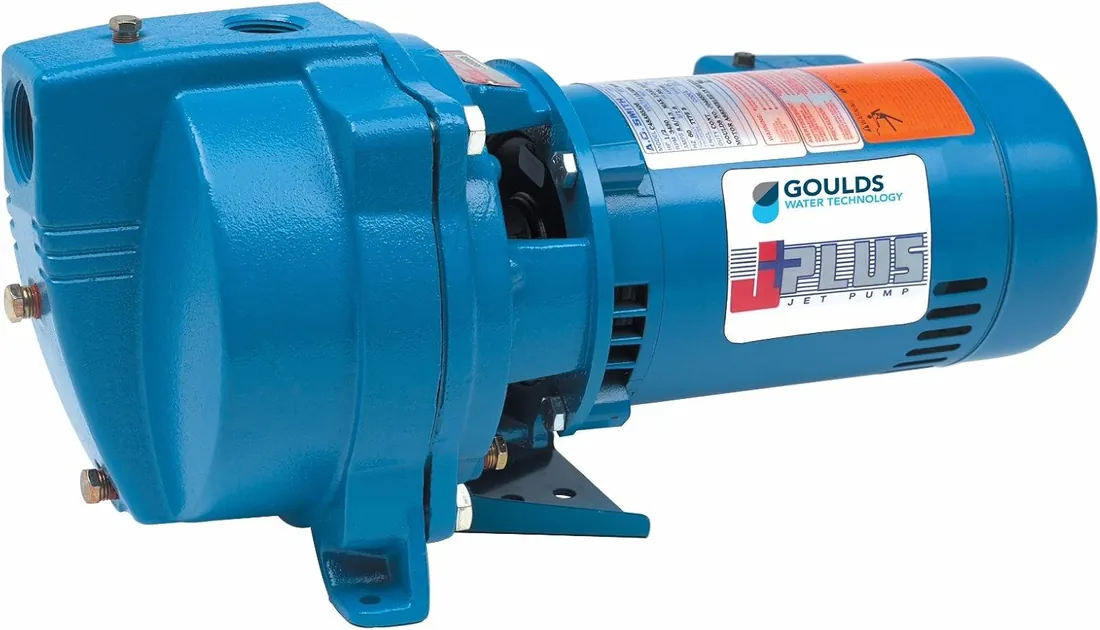
Quick verdict
The J5S is a long-running design aimed at homes and cottages with water close to the surface. Its strengths are serviceability, with a back pullout that leaves the piping in place, and a diaphragm that keeps the seal wet. At 50 psi it gives only 5 GPM even from a 5 ft lift, so it suits households content with the lower end of the switch band.
Who it fits, and who should skip it
A good fit if
- A cottage or small home drawing from a shallow well or lake.
- Owners who want to service the pump without cutting pipes.
- Sites where the pump may also boost an existing supply.
Look elsewhere if
- Households that need strong flow at 50 psi.
- Water deeper than 25 ft, which needs a convertible jet.
Specifications
Motor
| Horsepower | 1/2 HP |
|---|---|
| Voltage | 115/230 V, capacitor start, single phase |
| Speed and protection | 3500 RPM; built-in automatic-reset overload |
Figures: Goulds JS shallow well jet pumps technical brochure BJS+ R4 (distributor copy).
Performance
| Max flow | 17.5 GPM at 20 psi, 5 ft lift |
|---|---|
| Max head | 63 psi shut-off at a 5 ft lift |
| 5 ft lift: 30 / 40 / 50 psi | 16.5 / 10.2 / 5.0 GPM |
| 15 ft lift: 30 / 40 / 50 psi | 12.5 / 8.0 / 3.6 GPM; shut-off 59 psi |
| 25 ft lift: 30 / 40 / 50 psi | 8.6 / 6.2 / 1.3 GPM; shut-off 54 psi |
Figures: Goulds JS shallow well jet pumps technical brochure BJS+ R4 (distributor copy).
Controls
| Switch type | AS4 pressure switch preset 30/50 psi |
|---|
Figures: Goulds JS shallow well jet pumps technical brochure BJS+ R4 (distributor copy).
Connections
| Discharge | 1 in NPT |
|---|---|
| Suction | 1-1/4 in NPT |
Figures: Goulds JS shallow well jet pumps technical brochure BJS+ R4 (distributor copy).
Build
| Jet parts | Nozzle AN017, venturi AD3332, built into the casing |
|---|---|
| Impeller | Glass-filled engineered composite; stainless wear ring in diffuser |
| Weight | 43 lb |
| Max water temperature | 140 °F |
| Warranty | 1 year from installation or 18 months from date code |
Figures: Goulds JS shallow well jet pumps technical brochure BJS+ R4 (distributor copy); Goulds jet pump installation manual IM102 (third-party copy).
Versions
The JS series shares one casing design across several motors. The J5SH is a 1/2 HP high-pressure version with a different nozzle and venturi.
| Version | Part number | What differs | Listing |
|---|---|---|---|
| J5S, 1/2 HP | J5S | Nozzle AN017, venturi AD3332 | View on Amazon |
| J5SH, 1/2 HP high pressure | J5SH | 11.0 GPM at 40 psi from a 5 ft lift; shut-off 83 psi | Not linked |
| J7S, 3/4 HP | J7S | 18.3 GPM at 40 psi from a 5 ft lift | Not linked |
Figures: Goulds JS shallow well jet pumps technical brochure BJS+ R4 (distributor copy).
Installation and setup
Goulds' manual puts the emphasis on the suction line. Use pipe at least as large as the 1-1/4 in suction, and go a size larger on offsets over 50 ft. The line must run straight or slope upward to the pump; a hump or dip traps air and makes priming very hard. As the manual puts it, pumps do not hold prime, piping and check valves do.
In a well of 2 in or larger, hang a foot valve at least 5 ft off the bottom. On a sand point, an inline check valve near the well head works instead. Double-clamp barbed poly fittings, because one leak will stop the pump making pressure.
On the outlet, install a tee with a plug or gauge in its top port to use for priming. Keep valves and filters out of the line between pump and tank, other than a full-port valve, or the switch may chatter.
Switch and sizing notes
The AS4 switch comes preset to 30/50 psi; set the tank 2 psi below cut-in. The switch settings guide covers when a higher band makes sense, but this pump's table argues against it.
Size by lift and look at 40 psi, the middle of the band. From 10 ft the J5S gives 9.2 GPM at 40 psi; from 20 ft, 7.1 GPM. If your household needs more, the high-pressure J5SH holds pressure better and the 3/4 HP J7S moves more water. A suction-line ball valve can throttle the pump on a low-yield well.
Ownership and maintenance
The design is built to be serviced: the back pullout lets you remove the motor and impeller without touching the piping, the nozzle has its own clean-out plug, and the plastic fittings seal hand-tight on O-rings. A diaphragm keeps water around the mechanical seal so it cannot run dry, and the pump re-primes itself once water returns above the foot valve.
Goulds' warranty runs one year from installation or 18 months from the date code, whichever comes first.
Pros and cons
Pros
- Jet built into the casing, no separate adapter.
- Back pullout service without disturbing pipes.
- Seal protected by a water-retaining diaphragm.
- Full table at four pressures and five lifts.
Cons
- Only 5 GPM at 50 psi even from 5 ft.
- Warranty is short at one year.
- Limited to shallow water within 25 ft.
Alternatives worth comparing
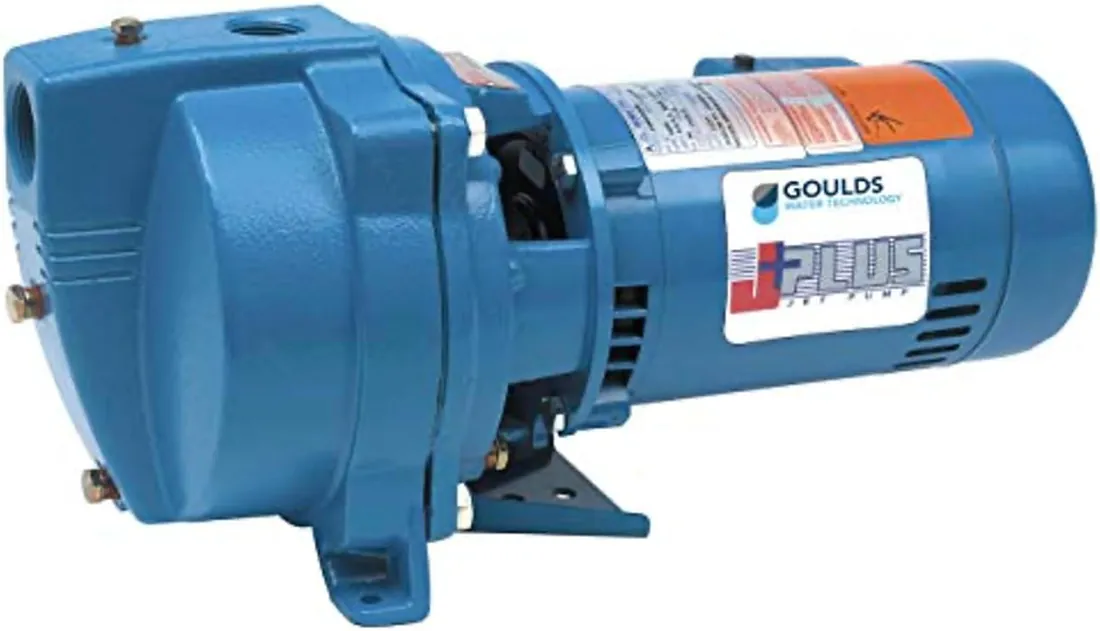
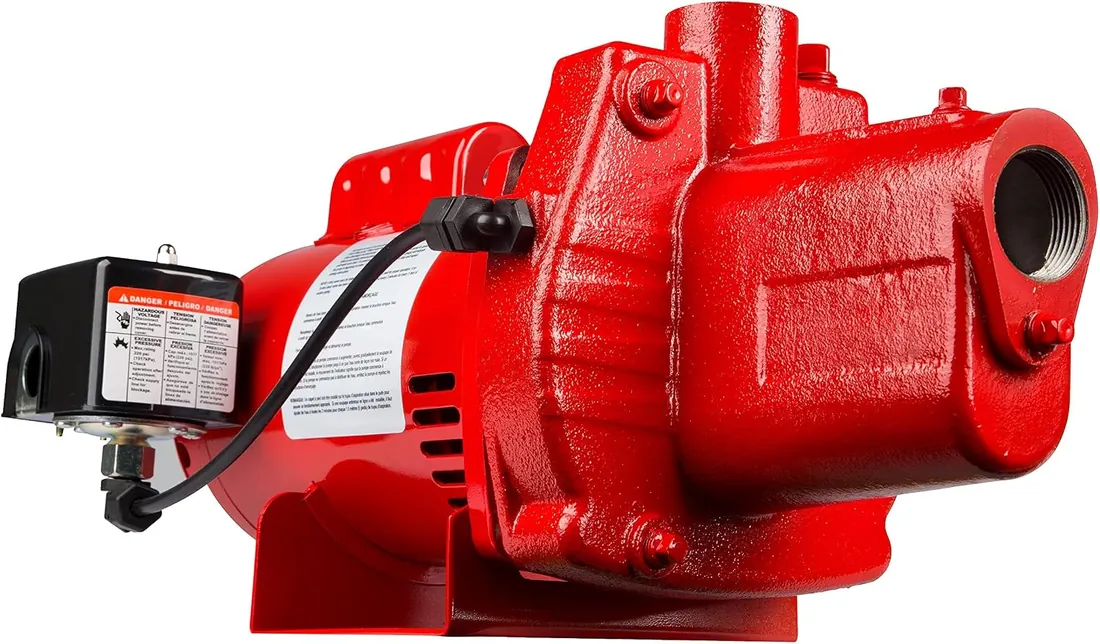
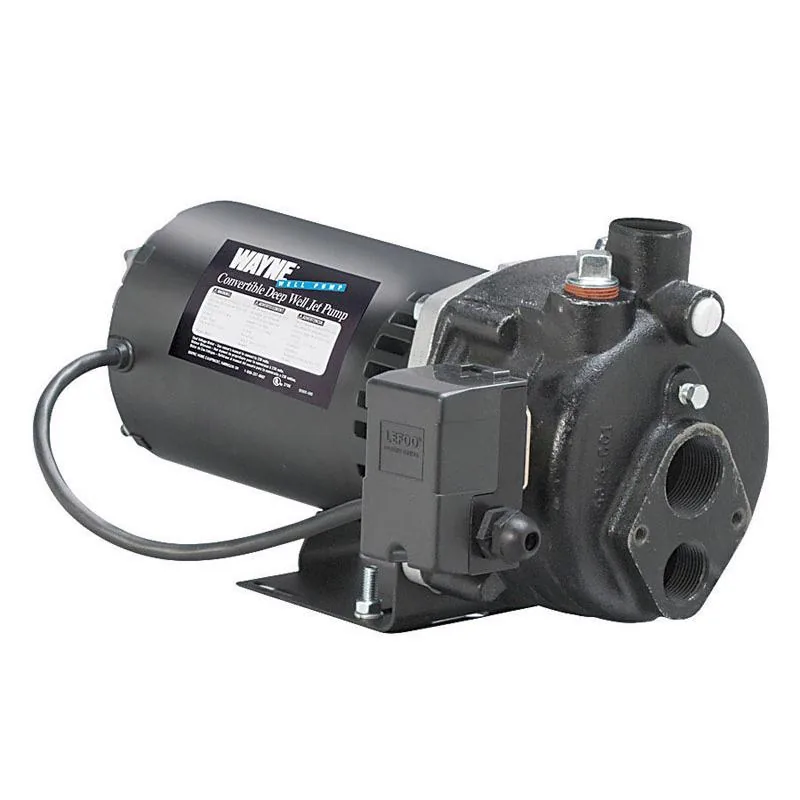
Compared with and featured in
Final verdict
Choose the J5S for a small household on a shallow source that values easy service and a protected seal. If you need pressure above 40 psi or more water, look at the J5SH or a larger JS motor.
Where to buy
Each button opens this exact model's listing. We may earn a commission on tracked links; it never changes what we publish. Disclosure
Questions buyers ask
How much water does the Goulds J5S pump?
Goulds rates it at 16.5 GPM at 30 psi and 10.2 GPM at 40 psi from a 5 ft lift. From 25 ft it gives 8.6 GPM at 30 psi and 6.2 GPM at 40 psi. Flow falls quickly above 40 psi.
What is the difference between the J5S and J5SH?
Both are 1/2 HP. The J5SH uses a different nozzle and venturi to hold higher pressure, with an 83 psi shut-off from 5 ft against 63 psi for the J5S, at the cost of less flow at low pressure.
Why does my J5S lose prime?
Usually the suction line. Goulds stresses that piping and check valves hold prime, not the pump, and that high spots, dips or a single leak in the suction pipe will stop it. Check clamps, unions and the foot valve.
How long is the Goulds warranty?
The manual gives one year from installation or 18 months from the date code on the pump, whichever comes first. Keep a note of the installation date on record alongside the receipt.