A pool cover pump is a small submersible pump placed on a closed pool cover to remove rainwater through a garden hose. Automatic models sense water and run on their own: Little Giant's APCP-1700 starts at 2 in and stops below 1 in, and Wayne's WAPC250 starts at 2-1/8 in and stops near 3/4 in. Manual pumps run whenever plugged in and must be unplugged before they run dry.
What a pool cover pump does
A solid winter cover collects every rain and every thaw, and water left sitting on it adds weight. Little Giant puts the risk directly: water left on a cover for long periods can rip or tear it. A cover pump sits on the cover where water pools, and pushes the water off through a garden hose to a drain or the yard.
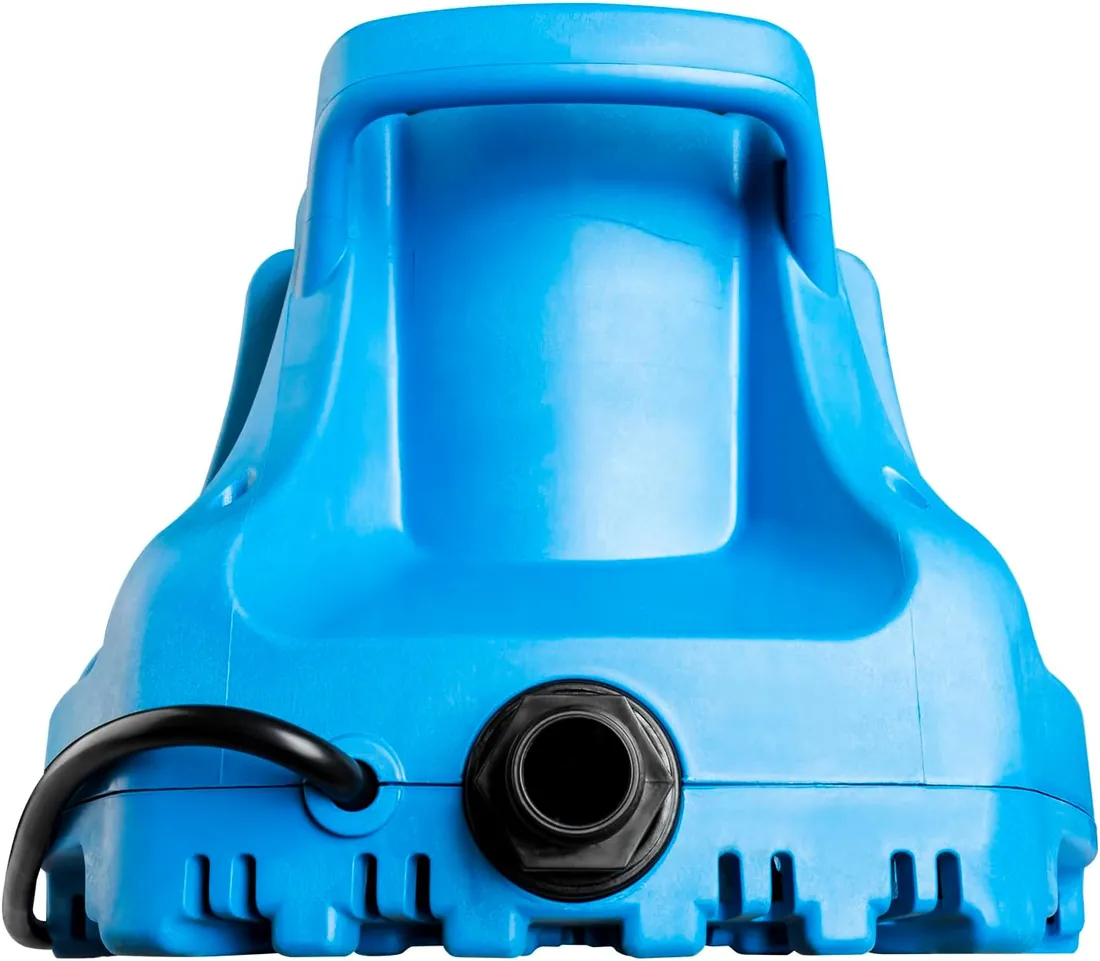
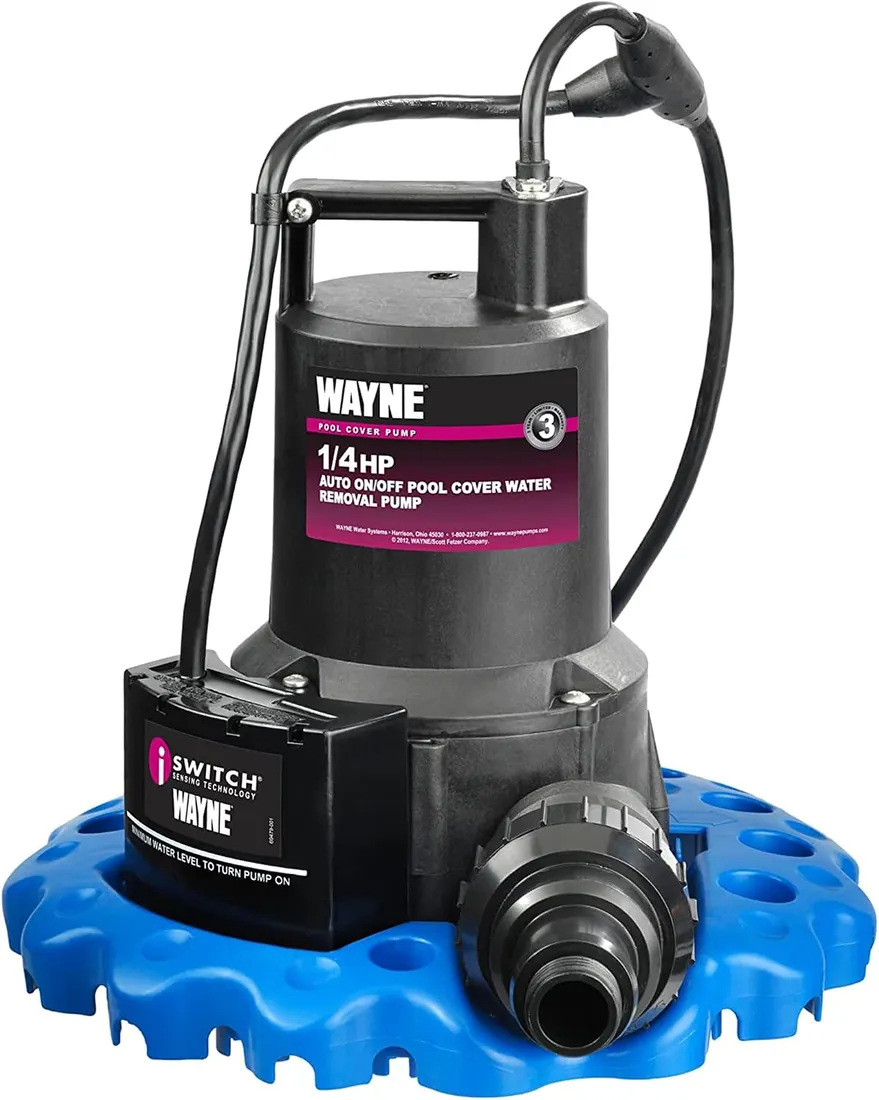
Cover pumps are light, have a wide base to stay upright on a soft surface, a bottom or side intake with a screen, and a long cord, usually 25 ft so the plug can stay well away from the pool. Both Little Giant's APCP-1700 and Wayne's WAPC250 ship with 25 ft cords, and Wayne includes a 25 ft rope to pull the pump into the middle of an above-ground pool cover.
| Pump | Starts at | Stops at | Flow | Discharge |
|---|---|---|---|---|
| Little Giant APCP-1700 | 2 in of water | Below 1 in | 1,745 GPH at 1 ft, 1,230 GPH at 10 ft | 1 in FNPT with 3/4 in hose adapter |
| Wayne WAPC250 | 2-1/8 in of water | About 3/4 in | 3,000 GPH max, 2,400 GPH at 5 ft | 1-1/4 in with check valve and 3/4 in hose adapter |
Figures: Little Giant APCP-1700 spec sheet M5282; Wayne WAPC250 operating instructions 620015W-001 C; Wayne WAPC250 sell sheet.
Automatic vs manual
An automatic cover pump has a built-in sensor or float that starts it when water reaches a set depth and stops it when the water is gone. You plug it in and leave it for the season. Wayne's iSwitch senses the water itself; Little Giant's APCP-1700 has a float under an access cover. Both also protect themselves from running dry, which matters because a cover pump spends most of its time with nothing to pump.
A manual pump runs whenever it has power. That is fine when you are standing next to it after a storm, but it will run dry, and dry running ruins pump seals. Wayne's manual is explicit that its shaft seal depends on water. If you use a manual pump, stay with it and unplug it as soon as it starts drawing air. For leaving a pump on a cover unattended, an automatic model is the only sensible choice.
How to use a pool cover pump
Place the pump at the lowest point of the cover, where water collects. On an in-ground pool that is often near an edge; Wayne says that if a flotation device is used under the cover, the pump should go at the lowest point where water gathers. Attach a garden hose and run it off the cover and away from the pool deck, downhill, so the water does not drain back under the cover or into the pool.
Plug the pump into a grounded GFCI outlet, as both makers require. Wayne's pump waits for 2-1/8 in of water, then runs after a 2-second priming delay to let air escape, and stops near 3/4 in. Keep the cord and hose from being pinched on the pool edge. Clear leaves from the cover and the pump screen regularly; debris is what usually stops a cover pump.
- Sweep leaves and twigs off the cover.
- Set the pump upright at the lowest point.
- Run the hose off the cover and away from the pool.
- Plug into a GFCI outlet and watch one cycle.
- Check the intake screen after each storm.
Pool cover pumps in freezing weather
This is where the two makers' advice differs, so follow your own pump's manual. Wayne's WAPC250 manual says to remove the pump from service and store it indoors when temperatures drop below freezing, even though its sell sheet mentions freeze protection in the iSwitch. That protection is a locked-impeller circuit: if ice or debris jams the impeller, the pump shuts down, retries for a while, then rests for 12 hours, checking twice a day, before resuming. Unplugging it briefly resets the delay.
Little Giant's manual says not to let the unit freeze, because ice can crack or distort it, but adds that if the pump is left installed in freezing conditions, the power cord should stay connected to power. Either way, a pump frozen into a sheet of ice on the cover cannot clear the meltwater around it.
Pool cover pump vs sump pump or skimmer
A sump pump is designed to sit in a pit with its intake at the bottom and a switch that needs several inches of water depth. On a flat cover it would never start, and it is heavy enough to stress the cover. A pool cover pump is built for shallow water spread over a wide area. Little Giant's float starts its pump at only 2 in.
A skimmer is a different thing again: the opening in the pool wall that feeds the filter pump. It is not used once a pool is closed and covered. For draining the pool itself, a submersible utility pump with more flow is the better tool; the submersible utility pump list and the pool cover pump list compare both.
Keeping a cover pump working
Little Giant's periodic service is simple: unplug the pump, remove five screws from the outer cover, take off the cover, and clean debris from the vent hole, then check the float area through its access cover. Wayne's iSwitch housing can collect grime, which Wayne says to clean gently with a small brush and soapy water. Both pumps have sealed motors with no internal service.
Wayne backs the WAPC250 with a three-year warranty. At the end of the season, clean the pump thoroughly and store it dry and indoors.
Common mistakes
- Leaving a manual pump plugged in on the cover unattended.
- Setting the pump on a high spot where water never reaches it.
- Letting the discharge hose drain back onto the cover.
- Leaving the pump frozen into ice on the cover.
- Using a heavy sump pump on a pool cover.
Products that fit
Questions readers ask
What is a pool cover pump?
A light submersible pump placed on a closed pool cover to remove rain and snowmelt through a garden hose, so the weight of standing water does not damage the cover. Automatic models switch on and off by themselves.
Can I leave a pool cover pump on all winter?
Check your pump's manual. Wayne says to remove the WAPC250 and store it indoors when temperatures drop below freezing. Little Giant says not to let the APCP-1700 freeze, but if it stays installed, to keep it plugged in.
How much water does a pool cover pump need to start?
Little Giant's APCP-1700 starts at 2 in and Wayne's WAPC250 at 2-1/8 in. Below that, the pumps wait. Wayne's stops at about 3/4 in, so a thin film of water always remains on the cover.
Can I use a sump pump instead of a pool cover pump?
Not well. A sump pump's switch needs deeper water than a cover holds, and its weight can stretch the cover. A cover pump is designed for shallow water spread over a wide surface.