Quick verdict
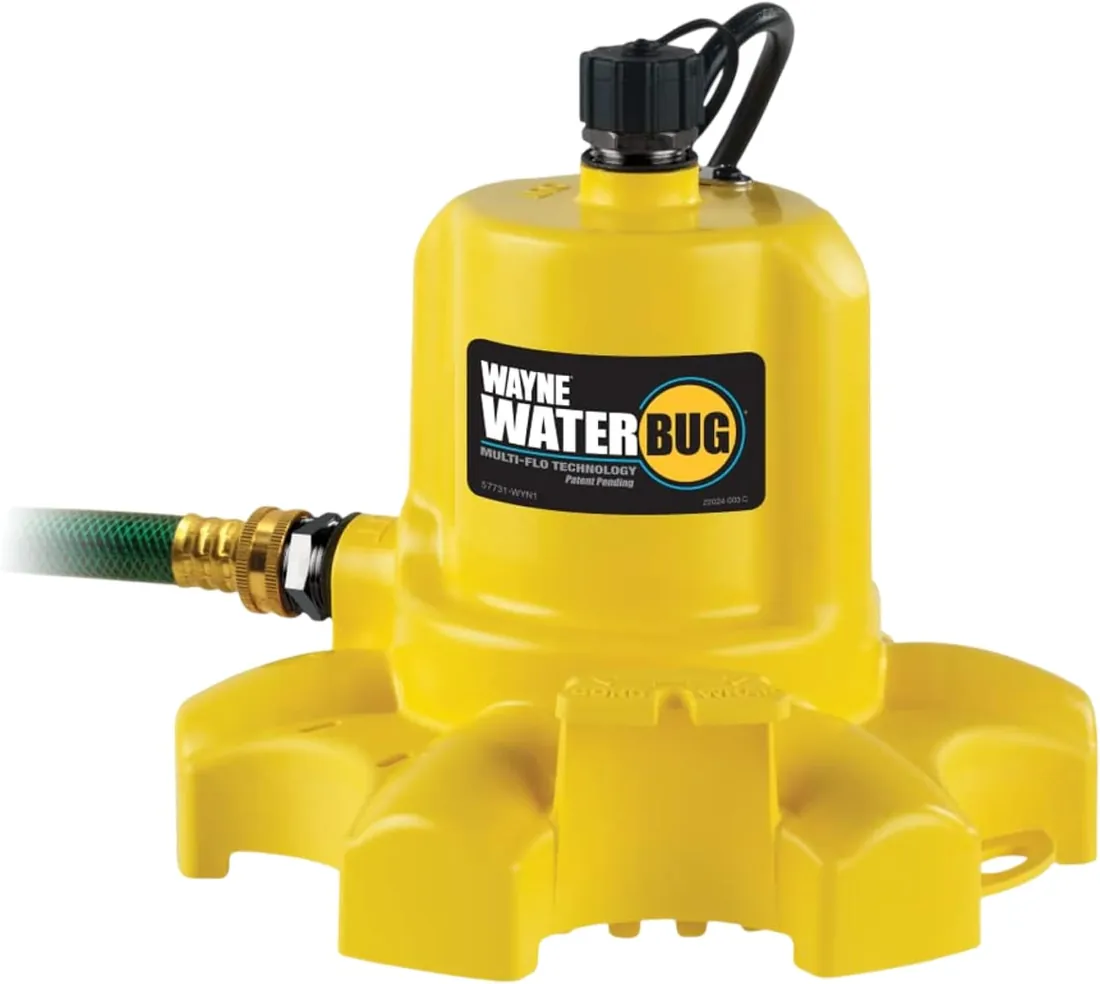
The WaterBUG is built around one idea: get a flat surface as close to dry as a pump can. Its wide, low body, layered debris strainer and choice of two outlets make it handy on flooded floors, flat roofs and in window wells. It is a garden hose pump with modest flow, a one-year warranty and no switch, and Wayne says it is not for ponds with fish.
Who it fits, and who should skip it
A good fit if
- You want to clear a basement floor, patio or flat roof as close to dry as possible.
- You work in tight spots such as laundry tubs, buckets or window wells and want a top outlet.
- You already own garden hoses and want a pump that threads straight onto them.
- Your lift is under about 10 ft, where Wayne lists 1,010 GPH.
Look elsewhere if
- You need to empty a fish pond; Wayne says it is not suitable for aquatic life.
- You want it to switch on and off by itself.
- You need big flow through wide hose for a deep flood.
Specifications
Motor
| Horsepower | 1/6 HP |
|---|---|
| Voltage | 120 V, 60 Hz |
| Motor type | Single phase, dielectric oil filled, sealed housing |
| Circuit | 15 A minimum, GFCI-protected |
Figures: Wayne WaterBUG operating instructions and parts manual 620009W-001 E; Amazon listing B018LRUDUU.
Performance
| Max flow | 1,350 GPH at 0 ft |
|---|---|
| Flow at 5 / 10 / 15 ft | 1,190 / 1,010 / 815 GPH |
| Flow at 20 / 25 ft | 600 / 360 GPH |
| Max head | 25 ft |
Figures: Wayne WaterBUG operating instructions and parts manual 620009W-001 E; Wayne WaterBUG WWB sell sheet.
Switch
| Switch type | None: runs while plugged in |
|---|
Figures: Wayne WaterBUG WWB sell sheet; Wayne WaterBUG operating instructions and parts manual 620009W-001 E.
Build
| Discharge | Two 3/4 in garden hose outlets, top and side, with screw-on caps |
|---|---|
| Pumps down to | About 1/16 in on a level surface |
| Water needed to start | 3/16 in |
| Construction | Thermoplastic housing and impeller, stainless steel shaft |
| Impeller | Closed centrifugal, bottom suction |
| Power cord | 10 ft, with cord wrap and hang loop |
| Size and weight | 11 x 11 x 10 in; 8 lb |
| Warranty | 1-year limited |
Figures: Wayne WaterBUG operating instructions and parts manual 620009W-001 E; Wayne WaterBUG WWB sell sheet.
Versions
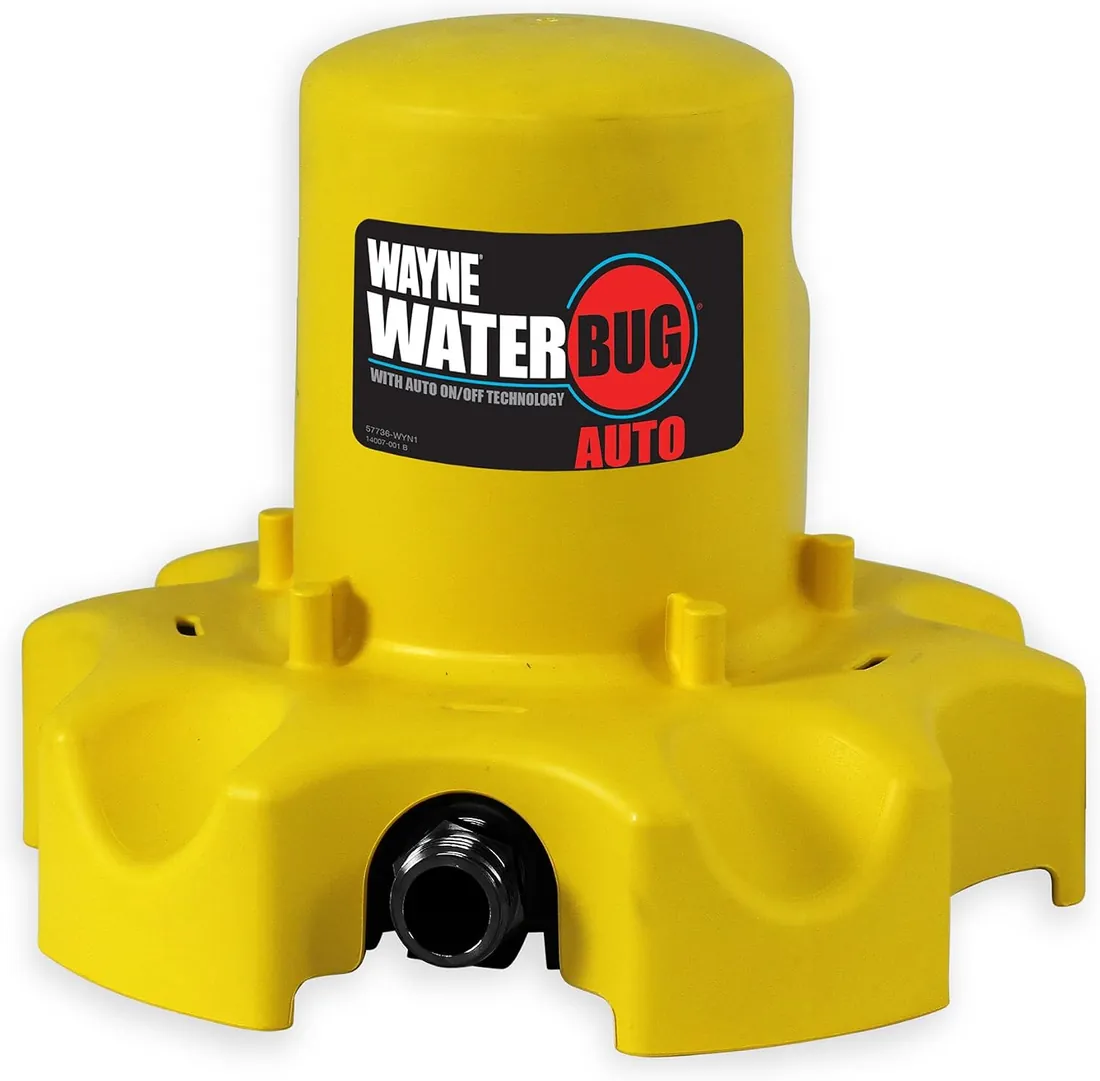
This page covers the original WaterBUG. Wayne also sells an automatic version with a float switch, listed separately.
| Version | Part number | What differs | Listing |
|---|---|---|---|
| WaterBUG WWB, manual | 57731-WYN1 | 1/6 HP, two 3/4 in hose outlets, 10 ft cord | View on Amazon |
Figures: Wayne WaterBUG WWB sell sheet; Amazon listing B018LRUDUU.
Installation and setup
Pick the outlet before you start. Wayne suggests the top discharge for tight spaces such as laundry tubs, window wells and buckets, and the side discharge for broad, flat areas such as flooded basements, flat roofs and yards. Thread a garden hose onto the one you choose and make sure the cap on the other is screwed down tight: if the unused outlet is open, water will not go through the hose. A hose washer, not supplied, stops leaks at the joint.
Unwind the hose fully, since kinks slow both priming and pumping. Then set the pump on a clean, hard surface; mud and sand clog the strainer from below. If there is no clean surface, a flat board or a bucket lid works, though Wayne notes it raises the starting and pump-down levels. Plug into a grounded GFCI outlet rated for at least 15 A, and the pump starts at once.
Switch and sizing notes
There is no switch. The pump runs as soon as it has power. It needs about 3/16 in of water to self-prime and pulls a level surface down to roughly 1/16 in. As the water thins it gets noisy and slows because it is drawing air; once water stops leaving the hose, unplug it so the shaft seal does not run dry.
Wayne's table runs 1,350 GPH at 0 ft, 1,190 at 5 ft, 1,010 at 10 ft, 815 at 15 ft, 600 at 20 ft and 360 at 25 ft. The manual says that if the end of the hose is 25 ft or more above the water, the lift is too high. A long garden hose adds friction too, so the sizing calculator is useful when the hose must climb out of a basement and run across a yard.
Ownership and maintenance
The motor housing is sealed and needs no service. Check the inlet before each use and clear leaves or grit from the outside of the strainer rings. If flow drops, unplug the pump, remove the six inner screws on the base (not the outer ones), lift the screen, clean the impeller and screen, reseat the cork gasket and refit the screen without overtightening.
Wayne covers the WaterBUG for one year from purchase. The manual rules out salt water, laundry discharge, highly chlorinated water and use with aquatic life, so keep it to clear water. Store it with the hose disconnected and the caps on.
Pros and cons
Pros
- Pumps a level floor down to about 1/16 in.
- Top and side outlets for different jobs.
- Starts with only 3/16 in of water.
- Full flow table from Wayne up to 25 ft.
Cons
- Garden hose outlets limit flow on big floods.
- One-year warranty from Wayne.
- Not suitable around fish or for salt water.
Alternatives worth comparing
Compared with and featured in
Final verdict
The WaterBUG is a smart buy when leaving a floor nearly dry matters more than speed, and when a garden hose is all you need. If it must run by itself or move big volumes, choose the AUTO version or a larger pump.
Where to buy
Each button opens this exact model's listing. We may earn a commission on tracked links; it never changes what we publish. Disclosure
Questions buyers ask
How dry does the Wayne WaterBUG leave a floor?
Wayne says it removes water down to about 1/16 in of the surface it sits on, provided the surface is level and clean. Standing it on a board or bucket lid raises that level slightly. A towel or squeegee finishes the last film.
Why is no water coming out of the hose?
The most common cause is the unused outlet: its cap must be screwed on, or water escapes there instead of through the hose. After that, check for kinks, a clogged inlet screen, low voltage, or a lift of 25 ft or more.
Can I use the WaterBUG to drain a pond with fish?
Wayne's manual says the pump is not suitable for use with aquatic life, and it also rules out salt water, laundry discharge and highly chlorinated water. Use it for clear water such as flooded floors, tubs and window wells.
What horsepower is the WaterBUG?
The owner's manual lists 1/6 HP, which matches the retail listing. The automatic WaterBUG AUTO is a different pump at 1/4 HP, with its own float switch and flow ratings.